














Register

Technicalities: Speaking of Jets

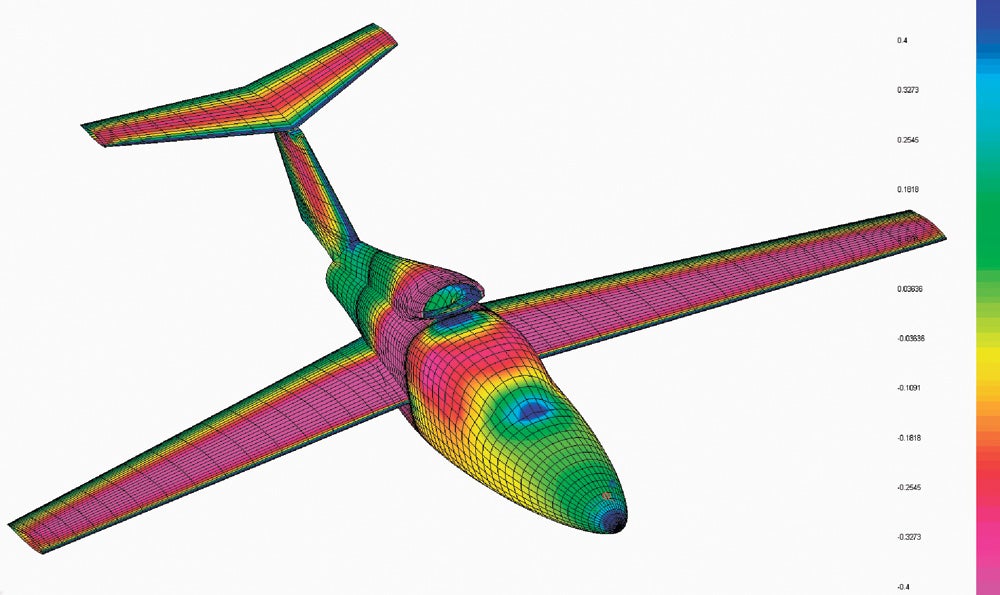
**Garrison's proposal for a four-seat
single-engine jet. It was judged less cool
than an X-tailed design with an engine
on a pylon above the rear fuselage.
**
Gemini Sparkle

Key Takeaways:

  • A conventional jet aircraft cannot exceed its own exhaust velocity because thrust is generated by accelerating the air passing through the engine; if the aircraft outpaced its exhaust, there would be no net acceleration or thrust.
  • The article details X-Plane creator Austin Meyer's ambitious project to develop a four-seat jet for homebuilders, highlighting challenges like securing engines from manufacturers and clarifying misconceptions about jet engine fuel efficiency.
  • Designing a single-engine personal jet for amateur construction presents significant engineering hurdles, particularly regarding optimal engine placement, managing aircraft balance and stability, and accommodating increased fuel loads.
  • Meyer plans to utilize his X-Plane simulation software to test and iterate various design configurations, offering a modern, virtual prototyping approach to address complex aerospace design problems.
See a mistake? Contact us.

Certain universal questions pop up over and over, like “Why is there something, when there could be nothing?” or “Can a jet fly faster than its own exhaust velocity?” Let’s look at the second one; I’ll get back to the first in a future column.

Reciprocating engines inhale about 15 pounds of air for every pound of fuel they burn. This is the so-called “stoichiometric ratio” — the ratio at which every oxygen molecule in the air gets combined with a hydrocarbon molecule in the fuel, leaving no unconsumed oxygen or fuel at the end. Chemically combining the oxygen and fuel releases energy in the form of heat — which makes the engine go — as well as, in the ideal case, just carbon dioxide and water.

Peter Garrison

Peter Garrison taught himself to use a slide rule and tin snips, built an airplane in his backyard, and flew it to Japan. He began contributing to FLYING in 1968, and he continues to share his columns, ""Technicalities"" and ""Aftermath,"" with FLYING readers.

Ready to Sell Your Aircraft?

List your airplane on AircraftForSale.com and reach qualified buyers.

List Your Aircraft
AircraftForSale Logo | FLYING Logo
Pilot in aircraft
Sign-up for newsletters & special offers!

Get the latest stories & special offers delivered directly to your inbox.

SUBSCRIBE
