
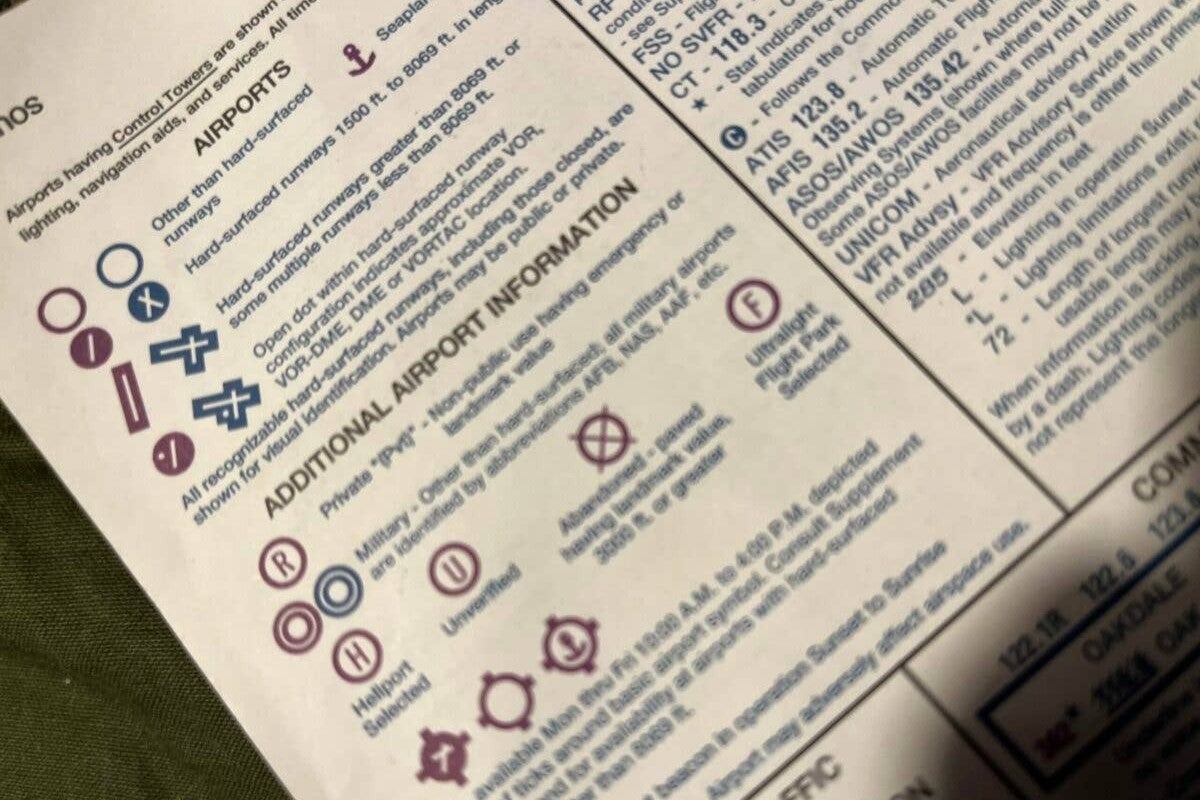

Returning to the cockpit can be a rewarding experience, but it’s a task that requires diligent preparation to be certain you are ready. No small number of incidents and accidents are caused by rusty pilots who got in too deep or fell behind their airplane.
Airspace navigation and associated planning tools tend to require “use-it-or-lose-it” knowledge, so it is vital that pilots are ready to thoroughly understand the airspace ahead and what that means for their flight. VFR pilots rely heavily on VFR sectional charts for navigation, airspace awareness, and hazard identification, so being able to read and properly interpret them is critical.
These maps—more correctly, charts—are designed specifically for VFR aviation and provide detailed information about terrain and landmarks that could be relevant to pilots. Perhaps most crucially, though, VFR sectional charts delineate airspace boundaries—both common airspace and special use airspace.
Understanding the Role of VFR Sectional Charts
VFR sectional charts utilize a unique design structure that helps display three-dimensional spatial information on a two-dimensional page (or, probably more likely these days, iPad screen). They help pilots visualize the invisible airspace around them and provide the framework within which pilots can plan flights and operate safely and legally within the regulations.
Purpose and structure
VFR sectional charts are the navigation resource most commonly used for en route flight under Visual Flight Rules. They are also frequently used for departures and arrivals, although pilots flying into or out of airports within the immediate vicinity of a class B or C airport can also utilize a more detailed Terminal Area Chart.
VFR sectional charts, in any event, are drawn to a 1:500,000 scale and aim to provide a balance between broad geographic coverage and detailed information.
Key elements include:
- Airports, with symbols that can indicate their layout, runway lengths, lighting systems, fuel availability, and other important information.
- Landmarks, such as rivers, highways, lakes, and populated areas, all of which can serve as visual reference points during flight.
- Terrain and obstructions, such as cell towers, tall buildings, and wind turbines. Their heights are displayed both as above ground level (agl) and mean sea level (msl). Sectional charts also show terrain elevation data, which can be especially useful when planning flights in or near mountainous regions, for example.
- Navigational aids (navaids), such as VORs, VORTACs, NDBs, and other ground-based navigation equipment. Charts will show facility names, Morse Code identifiers, frequencies, radials, and other relevant information.
- Airspace boundaries, denoting the locations of class B, C, and D airports, as well as special use airspace and various exceptions to standard Class E and G boundaries. These are all drawn such that, when properly interpreted, the pilot will be able to visualize the airspace three dimensionally using only the information provided on the chart.
Sectional charts are updated every 56 days by the FAA in order to reflect any changes to airspace boundaries, navigation aids, physical structures or landmarks, and potential hazards. Pilots can download free digital versions from the FAA’s website, as well as purchase printed charts and chart supplements from aviation retailers like Sporty’s Pilot Shop or Pilots HQ. These are also available and always up-to-date via a portable device as part of Electronic Flight Bags (EFBs) such as Foreflight.
Distinguishing VFR from IFR charts
While VFR sectional charts are optimized for visual navigation, focusing on terrain and physical landmarks, IFR (Instrument Flight Rules) charts prioritize instrument-based navigation.
IFR charts tend to look more sparse, lacking much terrain or landmark data in favor of providing much more detailed information relevant to established airways, fixes, frequencies, and navigational aids. While VFR sectional charts will be fairly colorful and will at least somewhat resemble maps that non-pilots are familiar with, IFR charts lack most topographic imagery and are white, primarily featuring lines that depict various routes.
Airspace Depictions on Sectional Charts
One of the most important uses of VFR sectional charts is determining in which classification of airspace a pilot is. It is vital to have a solid grasp on this, as airspace has a huge influence on the regulations pilots need to abide by, as well as on the communication requirements or expectations for which they will need to be ready.
Although sectional charts depict these classifications clearly, interpreting them correctly requires some familiarization. Since these might look deceptively familiar to rusty pilots, be sure to take the time you need to check your knowledge and to really and truly understand what you are looking at before jumping back into the cockpit.
Class A airspace
Located between 18,000 feet msl and FL 600, Class A airspace is exclusively for IFR operations. As a VFR pilot, you will not enter this airspace, and it is not depicted on VFR sectional charts.
Class B airspace
This airspace surrounds the nation’s busiest airports, such as KATL, KLAX, KJFK, or KORD. Class B airspace appears as solid blue lines and three dimensionally resembles an upside-down wedding cake, consisting of various “shelves.” The center of the airspace is located over the primary airport and extends to the ground, while each shelf has a floor and ceiling at designated altitudes over the ground. These altitudes will appear in blue and look like a fraction; the number on top of the “fraction” line represents the ceiling for that shelf, while the number on the bottom represents the floor. You will need to add two zeros to the end of the numbers to get the altitudes.
Class C airspace
Generally midsize, towered airports with radar service and a designated volume of scheduled passenger or cargo service will be surrounded by Class C airspace. Such airspace is depicted on a VFR sectional chart with solid magenta lines and circles. Like Class B airspace, this airspace resembles an upside down wedding cake, although one with only two tiers. Class C airspaces’ bottom layer usually has a 5 bm radius and extends from the ground, typically up to 4,000 feet agl. The second layer normally has a 10 nm radius and has a floor at 1,200 feet agl, extending to 4,000 feet agl.
Class D airspace
Smaller towered airports generally fall under Class D airspace. These airspaces are marked with dashed blue lines, usually have a 4-5 nm radius, and comprise a single layer that typically extends from the ground up to 2,500 feet agl ceiling. Most Class D airspaces are cylindrical, although there are exceptions. Since there are no additional layers and, thus, no floors above the ground, Class D ceiling altitudes in msl are displayed in a blue, dashed box (as opposed to resembling a fraction, as is the case with class B and C airspaces). As with class B and C, the ceiling altitude can be found by adding two zeros to the end of the number in the blue box—“25” would equate to 2,500 feet msl, for example.
Note that Class D airport control towers are usually (though not always) part-time, and will be closed after dark. When Class D control towers close, the airport usually becomes a Class G airport, and the tower frequency usually becomes the CTAF. Be sure to check the chart supplement for full details about the particular airport in question, though.
Class E airspace
Class E airspace can be thought of as the “everywhere else” airspace and represents the majority of controlled airspace not included in other classes. This means that most Class E airspace is not depicted, since it is mostly all airspace between 1,200 feet agl and 18,000 feet msl.
VFR Tools for Pilots
This does not mean that Class E airspace is never depicted, though. The most common depictions pilots will notice on a VFR sectional chart are Class E Transition Areas. These transition areas lower the Class E floor from 1,200 feet agl to 700 feet agl, usually over uncontrolled airports in Class G airspace in order to accommodate instrument approaches. Transition areas are depicted using thick magenta circles that are faded on the inside.
Another somewhat less common Class E depiction is of Class E to the ground. Since Class E rarely goes all the way to the ground, VFR sectional charts use a dashed magenta circle to depict this. These are located around Class E airports and look very similar to Class D airspace depictions, aside from the difference in color.
Because nearly all airspace between 14,500 feet and 18,000 feet msl is Class E, the transition from Class E to the ground to Class E from 1,200 feet ago is sometimes depicted in very high altitude areas. While this situation is very rare and most pilots will never encounter these spots, this transition is depicted with thick blue lines. Like magenta Class E transition areas, these blue lines are faded on one side. Anything on the faded side of the line is where Class E starts at 1,200 feet agl. The solid side of the line indicates Class G up to, but not including, 14,500 feet msl.
Class G airspace
Aside from the above example, Class G airspace is not depicted. Class G is the only uncontrolled airspace, and includes whatever airspace is found between the ground and the next lowest airspace overhead—typically Class E. Most nontowered airports are physically located inside Class G airspace because most Class G airspace goes up to either 700 feet or 1,200 feet agl.
Special Use Airspace (SUA)
Restricted areas, military operations areas, prohibited areas, warning areas, alert areas, and other special use airspaces are shown on VFR sectional charts to warn pilots of potential hazards or restrictions. Sectional charts clearly mark most of these zones—usually with either a square or a circle with hashes on the inside along with a basic textual description. It is important to review these airspaces in order to plan wise routes that avoid them when they are active, or if absolutely necessary, to secure the necessary permissions and clearances.
Modern Tools for Improved Navigation
Technology has transformed how pilots interact with their charts and how they navigate the skies over the last couple of decades. Combining traditional analog tools with modern digital ones enhances situational awareness, adds a layer of redundancy, and simplifies flight planning.
- Flight planning software: Applications such as ForeFlight and Garmin Pilot integrate sectional charts with real-time data, including weather, NOTAMs, and airspace alerts. These platforms allow pilots to visualize and address potential challenges before takeoff.
- Cockpit accessories: Products such as kneeboards and tablet mounts keep charts and digital devices organized and accessible during flight.
- Flight bags and organizers: Utilizing high-quality flight bags helps to ensure that charts, tablets, and other tools are neatly arranged and easily accessible during flight.
These tools bridge the gap between traditional practices and modern convenience, empowering pilots to focus on safe and efficient navigation.
Practical Steps for Returning Pilots
Returning pilots should strive to adopt a systematic approach to relearning VFR sectional charts and airspace rules. While VFR charts might look familiar at first glance, it is very likely that some of the contents within might throw you for a loop.
Start with local flights
Rebuilding confidence, knowledge, and proficiency begins with short flights in familiar areas. This allows pilots to associate chart symbology with familiar territory as they reacclimate their navigation abilities and their awareness of airspace.
Organize and equip
Keep things organized from the start. Knowing where everything is, both on the chart and in the cockpit reduces in-flight stress. Well organized flight plans—whether on paper, on the iPad, or both—along with functional gear keep navigation tools accessible and easy to manage. The easier things are to manage, the easier it will be for the returning pilot to stay ahead of the airplane.
Connect with other pilots
In addition to brushing up with an instructor, local flying clubs and even some online forums can provide a supportive environment to exchange knowledge, tips, and encouragement.
Practice with charts
Take time to practice. Plot routes, identify airspace on unfamiliar sectional charts, and think through all the potential hazards that flying those practice routes might present. Repetition will make chart reading second nature and will help to reinforce important knowledge.
Relearning VFR sectional charts is an essential step for ensuring safe and enjoyable flight operations. By understanding airspace classifications, practicing chart interpretation, and utilizing modern tools, pilots can rebuild their skills, confidence, and above all else, proficiency.
FAQ
What are VFR sectional charts used for?
VFR sectional charts are used for visual navigation. They help pilots identify landmarks, airspace, and possible hazards they might encounter during flight.
Where can free VFR sectional charts be obtained?
Pilots can access digital sectional charts for free from the FAA’s website. EFBs such as ForeFlight also offer updated charts, along with many additional features.
How long is a VFR sectional chart valid?
Sectional charts are updated every 56 days to reflect any changes in airspace, obstructions, airports, or other important information relevant to safe flight.
What landmarks are commonly included on sectional charts?
Sectional charts often depict landmarks such as rivers, mountains, highways, cities, and prominent man-made structures such as towers and wind turbines.
What is the scale of a VFR sectional chart?
VFR sectional charts are drawn to a 1:500,000 scale. This provides detailed information while covering a large geographic area.