











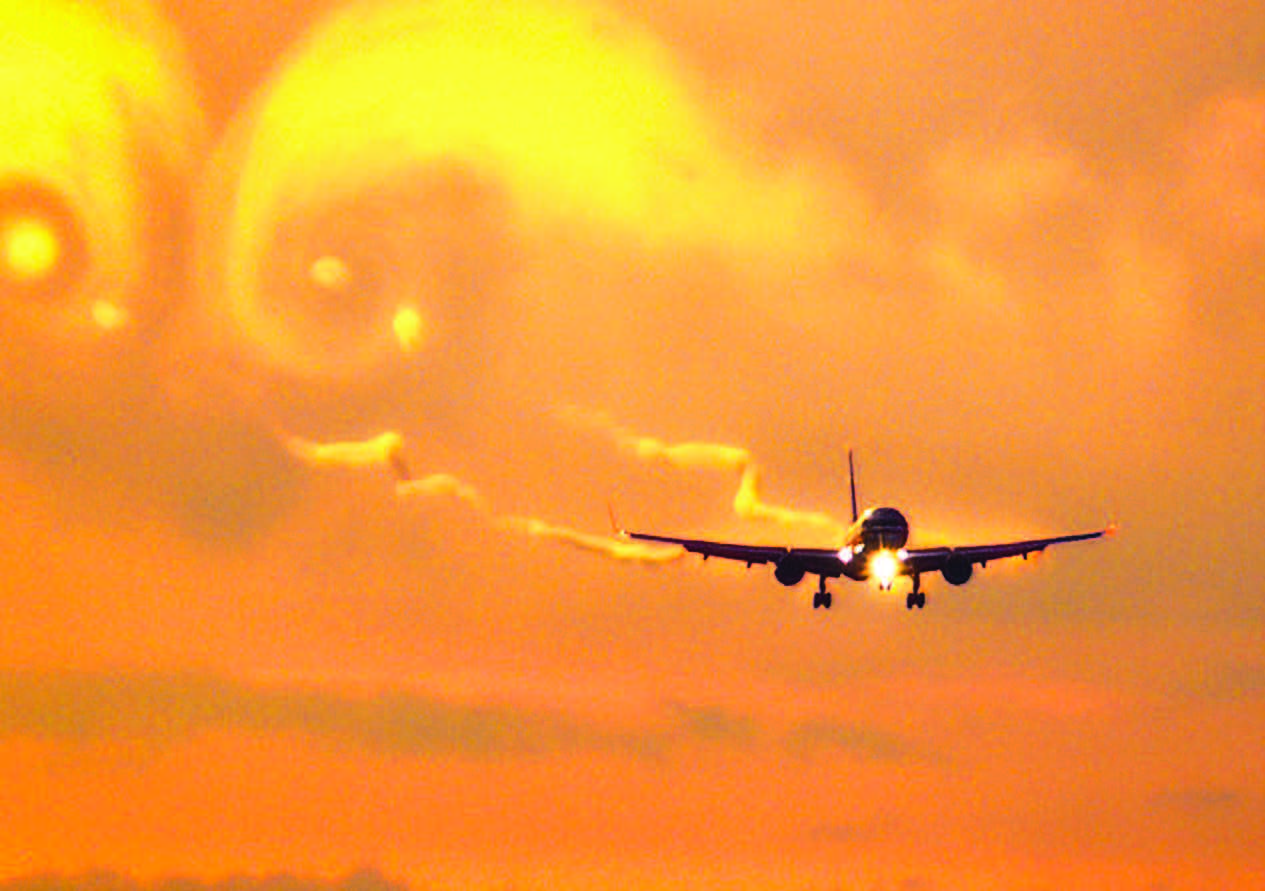


When people want to talk about something unpleasant, they often invent nicer-sounding phrases to disguise what’s really going on. “Wake turbulence” is the kind of term that can bring to mind vague, unpleasant imagery. “Wingtip vortices” sound nicer—more refined, perhaps—but actually may be more frightening.
The FAA’s definition in its Pilot’s Handbook of Aeronautical Knowledge (PHAK, FAA-H-8083-25C) doesn’t help much: “The rapidly rotating air that spills over an airplane’s wings during flight. The intensity of the turbulence depends on the airplane’s weight, speed, and configuration. Also referred to as wake turbulence. Vortices from heavy aircraft may be extremely hazardous to small aircraft.”

If you're not already a subscriber, what are you waiting for? Subscribe today to get the issue as soon as it is released in either Print or Digital formats.
Subscribe NowThat would get anyone’s attention.
What They Are
Wingtip vortices exist any time an airplane’s wing is generating lift. They slowly trail downward behind an airplane—yours included. Obviously, that makes them a concern whenever we’re operating near another airplane, which most often is when we also are near the ground. It’s one of those things that you have to expect, because by the time you figure it out, it may be too late to prevent a scare. Or worse.
Wingtip vortices are a kind of wake turbulence. To experience the difference, go out and fly a 360-degree steep turn at a constant altitude. At the end of a really good turn, the airplane flies through its own wake. That’s disturbed air, not the vortices. The vortices sink, so by the time the turn is done they are well below. That’s a good thing.
You usually can’t see wingtip vortices. Thanks to enterprising photographers, we have some great pictures of the vortices taken when an airplane flies toward the camera through dust or low clouds. Those conditions are rare, but the vortices are always there.
Where They Are From
Wake vortices are created by lift. Training manuals describe lift as a single entity with a complicated equation. Despite being complicated, the equation does not tell the whole story, because lift’s effects are far more complicated than the single number coefficient of lift (CL). If you only think about CL, an airplane can stall but never spin. A spin happens when each wing has a different coefficient of lift, which can happen if the airplane yaws at the stall.
Whether you root for Bernoulli, Newton, or even Coanda as the one who explains lift, everyone agrees that it happens when the pressure below the wing is higher than the pressure above. At the wingtip, air from the high pressure area under the wing moves to the low pressure area above it, which means it turns upward as it passes the tip. (Note: The PHAK incorrectly attributes this to the Bernoulli effect. It’s simply the case that air flows from high pressure to low.)
The texts all say that the wingtip vortices are strongest when the airplane ahead is heavy, clean, and slow. The number CL is a good reminder that, lacking airspeed, an airplane needs a bigger CL to produce enough lift to keep it in the air. When the airplane is slow, that happens at a higher angle of attack than when in cruise.
When do airplanes have a high angle of attack? Landing is one time, although generally airplanes aren’t “clean” then. Clean means landing gear, flaps, speedbrakes, and every other source of parasite drag is retracted. (Some airplanes even retract the entry step to minimize drag.) So one time when, say, a 737 is generating its strongest wingtip vortices is when it’s maneuvering to land in the terminal environment but before gear and flaps are extended. That’s not the same as saying the vortices generated by that same 737 with gear and flaps extended is benign.
Another time is just after liftoff, while still near the ground. Watch a departing 737 closely, and you’ll see its deck angle is a lot higher than the resulting climb angle. That difference is the angle of attack, and one reason for it is the 737’s relatively low speed, albeit in a clean configuration. So, climbs in the terminal area also generate strong wingtip vortices.
Challenges
Vortices coming from another airplane challenge pilots to think in four dimensions. There are the normal three that describe the geometry of how two airplanes are situated relative to each other in space and how that geometry is changing.
The vortices change with time, too, adding another dimension. Pilots have to think about what just happened and what is happening and what is about to happen. This thinking has to occur close to the ground, where there is far less room for error.
Effects
In 2017, a Bombardier Challenger 604 experienced an upset over the Arabian Sea a short time after it passed 1,000 feet under an Airbus A380. The bizjet reportedly rolled at least three times. Its crew declared an emergency and landed successfully in Muscat, Oman. The Challenger never flew again.
The good news, if possible in this context, is that the vortex tends to be small. That means that you might fly out of it, or hope that the “natural tendency is for the circulation to eject the aircraft from the vortex.” I don’t like the idea of being in an aircraft that is ejected from anything, but, as they say, it beats the alternative.
A really good place to find wingtip vortices is from aircraft operating near the ground. The vortices can’t sink, so they spread to either side. If you stay above or on the preceding airplane’s flight path, you’ll miss the vortices. This includes the standard strategies of landing past the touchdown point of an aircraft landing ahead and taking off before the point where the airplane ahead leaves the ground. On takeoff with a crosswind, it can help to sidestep upwind a little—with ATC approval.
Wind changes everything in aviation, and wake turbulence is no exception. One of my worst wake turbulence experiences happened at an airport with two parallel runways. I was on the right runway, and a large turboprop was on the left runway. There was a little crosswind from the left. The turboprop took off first, and the crosswind was just enough to blow its right-wing vortex, which had sunk a little, into my flight path. My airplane rolled close to 90 degrees in no time. I’d like to think that I recovered smoothly, but it might have been the case that we flew out of the vortex.
Air Traffic Control
Air traffic control (ATC) is supposed to warn pilots about wake turbulence when so-called small airplanes take off or land behind larger airplanes and impose a three-minute delay before takeoff to give the vortices time to dissipate.
Pilots can waive the wait but should be careful, because even small, light airplanes generate vortices. I was once in a Piper Archer flying a normal approach behind a Cessna 152 whose approach had been quite high. The vortex encounter was mild, but it was definitely there.
Training
A big problem with wingtip vortices, and wake turbulence in general, is that there aren’t many ways to train to handle it. If it can’t be done in an airplane, what about simulators?
In all of my sim training, the wake encounters have happened at approach altitudes, like 5,000 feet agl. Typically something like a McDonnell Douglas DC-10 or Boeing 757 would be flying in the opposite direction, 1,000 feet above, in night IMC. The simulated airplane would hit the wake, and the crew would go for a wild ride. I never felt that this training was realistic enough. The instructors could handle the recovery with their eyes closed, which reduced my confidence that it would help.
As the saying goes, there is no such thing as a free lunch—and lift has costs. One of them is wingtip vortices. If you’re the only airplane on the planet, you have nothing to worry about. Here, you’re not, so you have to look for the effects.

This feature first appeared in the July Issue 960 of the FLYING print edition.
