













Unintended Consequences

Having begun my pilot training with more than a few gray hairs, I spent almost the same number of hours in my 172, trying to perfect the important-to-me skill of smooth landings. Michigans weather exposed me to continuous crosswinds, along with a generous sprinkling of snow and ice-covered runways along the way. My Midwest landing and takeoff experience was rounded out in the summer by incorporating grass and short-field training from those with grayer (or less) hair. As the years and hours accumulated in the fickle, "occasional" cloud-covered Michigan skies, the next confidence builder was to obtain an instrument rating. Hours spent in a simulator, along with hood time and, eventually, a few flights in actual following the glideslope to the runway added to my confidence that landings could be routine.

Gemini Sparkle

Key Takeaways:

  • An experienced pilot encountered a critical "what-if" scenario during a sunset landing, where the setting sun completely blinded direct visibility of the runway.
  • Despite dark sunglasses and a sunshade, the pilot had to rely on side window guidance for the landing, resulting in a porpoising bounce.
  • The incident highlighted the significant hazard of blinding glare during sunset landings on westerly headings.
  • The key takeaway was that sunset landings are best accomplished on an easterly heading to avoid direct sun glare.
See a mistake? Contact us.

Having begun my pilot training with more than a few gray hairs, I spent almost the same number of hours in my 172, trying to perfect the important-to-me skill of smooth landings. Michigans weather exposed me to continuous crosswinds, along with a generous sprinkling of snow and ice-covered runways along the way. My Midwest landing and takeoff experience was rounded out in the summer by

288


incorporating grass and short-field training from those with grayer (or less) hair.

As the years and hours accumulated in the fickle, “occasional” cloud-covered Michigan skies, the next confidence builder was to obtain an instrument rating. Hours spent in a simulator, along with hood time and, eventually, a few flights in actual following the glideslope to the runway added to my confidence that landings could be routine.

As a reliability engineer concerned with consumer products, a major concern was always which what-if scenario have we overlooked in our testing? If something can go wrong, someone will find out how. Well this what-if scenario did occur during one of my landings and there was a lesson learned.

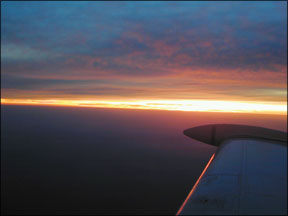
Returning home near summer sunset, I turned final to Runway 28 at a rural, non-towered airport. A slight crosswind required a crab. After a normal descent and with the traditional landing picture in view, I descended the last few hundred feet when the what-if scenario met the law of unintended consequences.

Even with a sunshade and dark sunglasses, the entire windscreen suddenly was ablaze from the setting sun. Direct visibility of the fast-approaching runway was gone; remaining guidance was through the side window.

In hindsight, I should have attempted an instrument go-around. Fortunately for the pilot and the plane, the porpoising bounce occurred within the 100-foot width of the runway.

Lesson learned: Sunset landings, although beautiful, also can be blinding. They are best accomplished on an easterly heading.

Ready to Sell Your Aircraft?

List your airplane on AircraftForSale.com and reach qualified buyers.

List Your Aircraft
AircraftForSale Logo | FLYING Logo
Pilot in aircraft
Sign-up for newsletters & special offers!

Get the latest stories & special offers delivered directly to your inbox.

SUBSCRIBE