











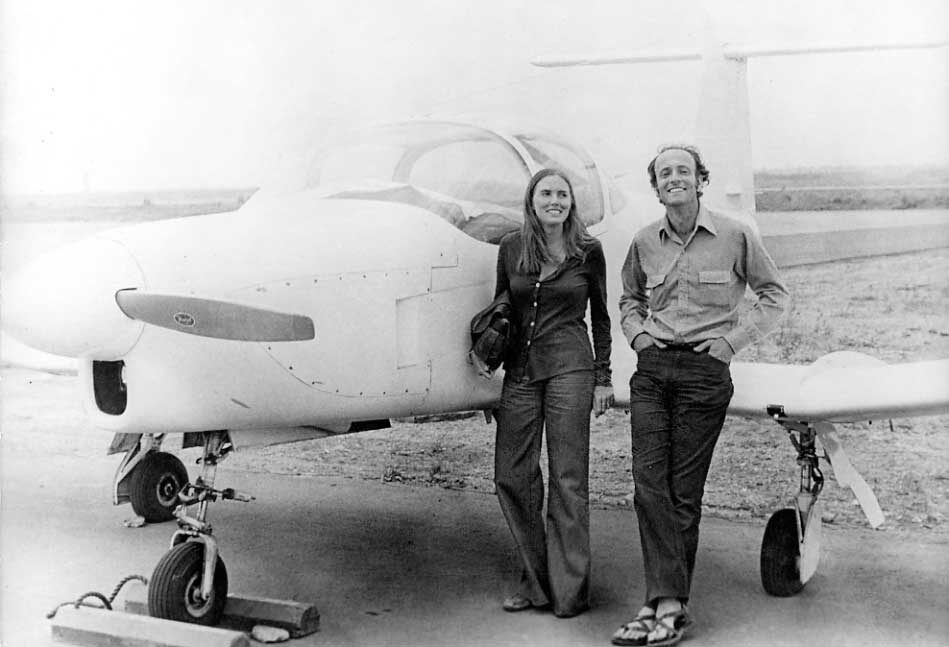


I first saw Nancy Salter in the kitchen of a dilapidated three-decker in Cambridge, Massachusetts, in summer 1967.
The only utensils in the kitchen were a few wrenches scattered around somebody’s partially dismantled motorcycle. We didn’t talk then, but I worked up the courage to call her the next day—quite a trick, for me—and ask her to a movie. In spite of her having to get up early the next morning to catch the first of three buses for work at the Winchester Star, she consented.
If you're not already a subscriber, what are you waiting for? Subscribe today to get the issue as soon as it is released in either Print or Digital formats.
Subscribe NowSgt. Pepper’s Lonely Hearts Club Band played on an endless loop that summer. I took Italian classes, and she wrote wedding announcements and obituaries. In September I left for Europe. It was during that year that I began the design of the first airplane that I would complete, started writing for FLYING, and at one point modeled, quite misleadingly, for a Playboy spread about the jolly gallivanting of Americans in Paris.
She came to Europe the following summer, having saved every other paycheck and acquired a copy of Europe on 5 Dollars a Day. Our paths crossed. I was on my way to California, land of surplus aluminum, to start building the airplane.
- READ MORE: Pilotless: This Is Your Robot Speaking
In June 1969, I was back in France, and with Nancy. We were at Le Bourget, north of Paris, with some people from Alpavia, the company that manufactured the Fournier gliderplanes (avions-planeurs). A single-seat, 36 hp RF-4 and a two-seat RF-5 needed to be flown to Toussus-le-Noble, southwest of the city. I took the RF-4. Nancy climbed into the back seat of the RF-5, the company pilot, Bernard Chauvreau, into the front. It was her first time in a small airplane.
I flew in right echelon on Chauvreau’s wing, always expecting Nancy to turn back and wave. She never did. She later explained that she was afraid that if she did, she might upset the balance of the airplane, which would tip over like a canoe.
A month later my father and I picked her up in Los Angeles. You could fly a Cardinal into KLAX to pick up a passenger in those innocent days. She says we had a near midair on the way back to Yucca Valley, where I was staying with my parents. I don’t remember it—but then Nancy’s idea of “near” may not have been the same as mine.
Three weeks later, I took her on a 34-hour round trip to Rockford, Illinois, then home of the EAA fly-in, in a Pazmany PL-1, a tiny 90 hp, two-seat homebuilt. By now I had persuaded Nancy that an airplane would not tip over if you turned your head, but, disposed to anticipate catastrophe, she still disliked flying. Nevertheless, she concealed her aversion well.
I didn’t have a plane then, but we flew a lot, sometimes in my father’s Cardinal, sometimes in the subjects of used-plane pilot reports for FLYING or in a Beech Sierra that had been put at the disposal of the Los Angeles writers. Nancy loved to travel, and I can’t imagine she didn’t enjoy at least some of the airplane aspects of it—like the time we put our two dogs, a Golden Retriever and a Samoyed, into the back of an amphibian and landed on a lake in Northern California. The dogs got up, took one appalled look out the window, and lay down again. They would have covered their faces with their hands, if they had had hands.
But the stories Nancy tells about our flying are always the horror stories.
There was the time we got lost in Guatemala—this was in 1974—and discussed whether the better course was to ditch my beloved Melmoth, then less than a year old, in a river or to parachute—yes, we had parachutes—into the jungle. Or the time we landed at Prescott, Arizona, in the Sierra and left a trail of ice slabs on the ramp as we taxied to parking. Or the thunderstorm we had to fly through at Puerto Vallarta, Mexico, when we found the whole coastline blocked by a line of storms. Nancy buried her face in a pillow but could still see the flashes of lightning. She wouldn’t speak to me for the rest of that evening.
Either because she dissembled well or because I lacked insight, I took Nancy’s consent for granted and embarked on increasingly bold projects. I say bold—she probably thought rash.
When we were about to make an 11-hour hop from Gander, Newfoundland, to Shannon, Ireland, she weighed her alternatives. She could take an airliner. But then the airliner might crash, and I would arrive safely—she was an equal-opportunity doubter. Or both Melmoth and Boeing might arrive safe, and then she would regret having missed the experience. Impossible to choose, so she climbed in, rested her stocking feet on the instrument panel, opened a novel, and was disappointed to find the restaurant at Shannon closed when we arrived.
The next year we flew to Japan. It’s difficult to convey the effect of the Pacific Ocean spreading out around you, mottled, silvery, and boundless, hour after endless hour. Panic keeps threatening to well up. Yet Nancy slept for half of the 15 hours. Once I inadvertently let a tank run dry. “Never do that again!” she explained, then went back to sleep.
After we returned from Japan, Melmoth had a series of alternator failures. I kept overhauling the alternators myself, and they kept failing. Those failures, along with a broken oil fitting that led to my landing on a road and spending the night there, awakened in Nancy an awareness that she had repressed: Something could go wrong, and if it happened at night or in IMC, our collective goose would be cooked. Night and IFR were banned thereafter except in emergencies, like wanting to get out of Okmulgee, Oklahoma.
Melmoth was run over by a landing Cessna in 1982. It took me 20 years to build my second airplane. During that time we raised two children, we got older, and Nancy got wiser, and her reluctance to fly increased. She tolerated one cross-country trip in the new airplane, and a hop over to Catalina Island for an old friend’s birthday. Then she hung up her scarf and goggles in the temple of the goddess of flight.
Now when I fly, I do so alone, and seldom far from home. I daydream sometimes about the quarter-million miles we traveled together, Nancy and I, night and day, sun and storm, and I reflect how different they must have felt to her than they did to me. Does she remember with any pleasure the mountains, deserts, cloud caverns, peaceful blue-sky plains, glaciers, jungles, and seas?
I do. It was grand—and grander still because she chose to come along.
This column first appeared in the July Issue 960 of the FLYING print edition.

