














Smithsonian Pushing Back on Plans to Relocate Space Shuttle

Big Beautiful Bill funds orbiter’s move to Texas.

Space Shuttle Discovery
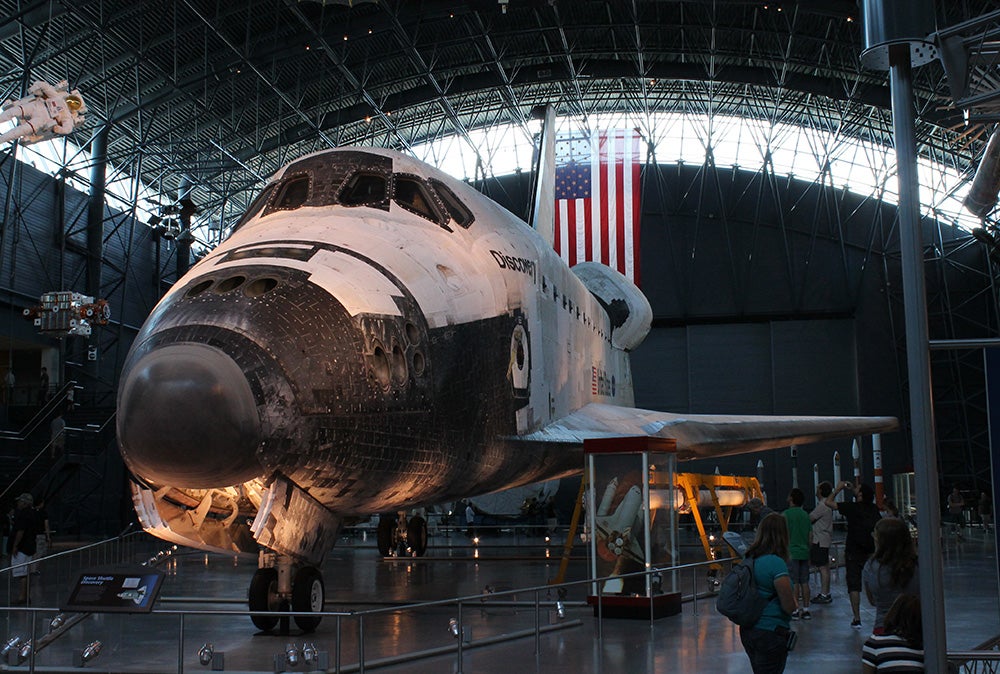
The space shuttle Discovery flew 39 missions and was responsible for launching the Hubble Space Telescope in 1990. [Courtesy: National Air and Space Museum]
Gemini Sparkle

Key Takeaways:

  • A new law, the One Big Beautiful Bill Act, allocates $85 million to move the retired Space Shuttle Discovery from its current home at the Smithsonian's National Air and Space Museum in Virginia to the NASA-run Johnson Space Center in Houston.
  • The Smithsonian Institution is fighting to retain ownership of Discovery, stating that ownership was transferred to them and that the government's attempt to remove it from their collection is "unprecedented."
  • Texas senators advocate for the shuttle's relocation to Houston, citing the city's aerospace legacy, while Virginia senators and the Smithsonian question the high cost and logistical challenges of the transfer.
See a mistake? Contact us.

There is a battle brewing over ownership of a retired NASA space shuttle.

The One Big Beautiful Bill Act, signed into law by President Donald Trump at the White House last week, sets aside $85 million to relocate the space shuttle Discovery from its current home at the National Air and Space Museum’s Steven F. Udvar-Hazy Center in northern Virginia to the NASA-run Johnson Space Center in Houston.


But the Smithsonian Institution, which operates the National Air and Space Museum, is fighting to keep the spacecraft. In a message sent to Congress, the organization said it would be “unprecedented” for the federal government to remove an object from its collection and send it somewhere else.

“The space shuttle Discovery is not on loan to the Smithsonian from NASA,” the message read. “Ownership was transferred to the Smithsonian’s National Air and Space Museum.”

Earlier this month, before the Big Beautiful Bill was signed into law, National Air and Space Museum Director Chris Browne told the Washington Business Journal that the museum maintains full ownership of the orbiter.

“Our position is that the Discovery is staying right where it is,” Browne said.

The Smithsonian was created by the federal government, and about two-thirds of its funding comes from federal appropriations. But its collections are not managed as federal property. It is not clear what route the Smithsonian could take, if any, to challenge the relocation measure.

Senator Tim Kaine (D-Va.) has taken the Smithsonian’s side in the tussle, arguing Discovery should stay in his state.

“What kind of message does it send to the American people when Republicans cut Medicaid and nutrition assistance funding that people rely on, while simultaneously authorizing $85 million in taxpayer dollars to move a space shuttle halfway across the country?” Kaine said. “This ridiculous transfer would make Americans pay a $30 fee to view a shuttle that they can see for free right now in Chantilly [Virginia].”

New Texas Home

Senator John Cornyn (R-Texas), who authored the shuttle relocation provision in the Big Beautiful Bill, has said Discovery is a powerful symbol of his state’s contributions to the aerospace industry and national space exploration efforts.

“Houston has long been the cornerstone of our nation’s human space exploration program, and it’s long overdue for Space City to receive the recognition it deserves by bringing the Space Shuttle Discovery home,” Cornyn said in a statement. “I am glad to see this pass as part of the Senate’s One Big Beautiful Bill and look forward to welcoming Discovery to Houston and righting this egregious wrong.”

The measure was backed by fellow Senator Ted Cruz (R-Texas), who joined Cornyn in introducing the stand-alone Bring the Space Shuttle Home Act in April. The language of that proposal was largely incorporated into the Big Beautiful Bill.

Transporting Discovery the roughly 1,200 miles between Virginia and Texas would be a complicated undertaking. The two Boeing 747s specially equipped to carry space shuttles, known as the Shuttle Carrier Aircraft (SCA), are both retired and on display, one in California, the other in Texas.

Moving the spacecraft by land would cost over $300 million and increase the risk of damage, according to the Smithsonian.

Discovery entered service in 1984 and flew 39 Earth-orbital missions, spending 365 days in space and traveling almost 150 million miles. It was retired in 2011, by which time it was the oldest surviving space shuttle orbiter. NASA transferred ownership of the spacecraft to the Smithsonian in 2012, and in April of that year it was flown to Washington Dulles International Airport (KIAD) and transported to the Udvar-Hazy Center.

Space Shuttle Discovery
Space Shuttle Discovery [File photo]

Six space shuttle orbiters were built for flight. Enterprise is on display at the Intrepid Sea, Air & Space Museum in New York, Atlantis is housed at the Kennedy Space Center in Florida, and Endeavour is held by the California Science Center, with plans for permanent display at the Samuel Oschin Air and Space Center.

Challenger broke apart shortly after launch in 1986, and Columbia disintegrated upon reentry in 2003. The two accidents killed a combined 14 people.

Zach Vasile

Zach Vasile is a writer and editor covering news in all aspects of aviation. He has reported for and contributed to the Manchester Journal Inquirer, the Hartford Business Journal, the Charlotte Observer, and the Washington Examiner, with his area of focus being the intersection of business and government policy.

Ready to Sell Your Aircraft?

List your airplane on AircraftForSale.com and reach qualified buyers.

List Your Aircraft
AircraftForSale Logo | FLYING Logo
Pilot in aircraft
Sign-up for newsletters & special offers!

Get the latest stories & special offers delivered directly to your inbox.

SUBSCRIBE
