Register

Search Results for: Lear 45

Pilot Proficiency

The Human Factor: Be Predictable

It was a normal Saturday morning. I had just left the bank and pulled up to the busy street to wait for a break in traffic so I could make a right turn. I had quickly checked to the right when I first stopped at the sidewalk, and then focused on the traffic approaching from […]

Read More »
Accident Probes

NTSB Reports August 2013: Recent General Aviation and Air Carrier Accidents

At about 0830 Eastern time, the airplane was substantially damaged during a forced landing. The engine lost all power shortly after takeoff. The airline transport pilot sustained minor injuries and a passenger was not injured. Visual conditions prevailed. The pilot reported taking off and climbed to 2500 feet msl when the engine began to vibrate and lose power, and the cabin began to fill with white smoke. The pilot shut down the engine and performed a forced landing to a soy bean field. During the landing roll, the airplane nosed over. The airplane was equipped with a Franklin 6A-350-C1, 220-hp engine. Initial examination revealed the No. 4 cylinder head was partially separated and the No. 4 cylinder piston was displaced.

Read More »
Pilot Proficiency

Alaska Wild in a Cessna 185

Last summer, my wife and I wanted to visit the Brooks Range in August to hunt Dall sheep. For those not familiar with it, the Brooks Range is a mountain range stretching about 700 miles from western Alaska across the state east to Canada’s Yukon Territory. From where we live in South Central Alaska, it […]

Read More »
Pilot Proficiency

Neil Armstrong: Knowing the Kid From Wapakoneta

The following article is from the January 2013 print issue. Way back in the early ’70s, an old friend of my husband’s, Harry Combs, invited us to join him and his wife at the National Aviation Hall of Fame enshrinement ceremony and dinner in Dayton, Ohio. Serving as master of ceremonies that year, Combs was […]

Read More »
Features

Becoming Your Own Test Pilot

Very few airplanes get precisely “book” performance. Some do better, some don’t quite meet the specs. Meanwhile, common piloting techniques differ from those recommended by the pilot’s operating handbook (POH) or airplane flight manual (AFM). It’s up to you to determine what is “normal” for your airplane, and the way you fly it. To learn what even a type-certificated airplane will truly do and when, you need to test-fly the airplane. For a time, I was the lead instructor for Beechcraft Bonanza training for an international flight safety organization working at the Beech factory airport. Part of the training we provided included flight in the customer’s airplane. One of the items on the flight training syllabus was to show different flying techniques, and compare actual performance received to that predicted by the POH.

Read More »
Accident Probes

Losing The Flick

The Flick,” the big picture, is how situational awareness often is described. As short descriptions go, it’s a good one. The big picture can mean different things to different people, of course, but it generally breaks down into knowing where you are, where you’re going, what it’s going to take to get there and whether the resources to complete the flight are available. The resources can be any number of things. In particular, they usually boil down to keeping tabs on fuel, weather and terrain. Lose the flick on either one of these three, and you could find yourself in these pages.

Read More »
Accident Probes

NTSB Reports July 2013: Recent General Aviation and Air Carrier Accidents

The pilot departed on a 1+50 cross-country flight with approximately 30 gallons of fuel in each wing tank (approximately 27 gallons usable fuel per side). The flight was uneventful until he started a descent from 8000 feet msl to 3000 feet, when the engine made “two pops” and “quit.” The pilot said there was no engine roughness, “It just stopped.” He made several attempts to restart the engine, but was unsuccessful. The pilot declared an emergency and landed in a field. Upon landing, the nose gear dug into the dirt and separated from the airplane.

Read More »
Videos

Video: Runway Disappears after Minimums

It looks like a routine ILS approach as the crew of a Boeing Business Jet descends through 500 feet toward the runway on a gray, rainy day. On reaching minimums at around 200 feet, the airplane is on glidepath and a landing appears certain as the rabbit lights and runway are clearly visible straight ahead. […]

Read More »
Pilot Proficiency

African Fly-It-Yourself Safari

Bravo Kilo Echo enters the pattern to circumnavigate Victoria Falls. (Photos by Mike Venturino and Michelle Carter)| At 6,500 feet, we could see the spray of Victoria Falls billowing above the Zimbabwe flatland 70 miles out. No GPS necessary, just head for the cloud of mist and keep the roiling Zambezi River below you. Strung […]

Read More »
Pilot Proficiency

Dangerous Flying Jobs

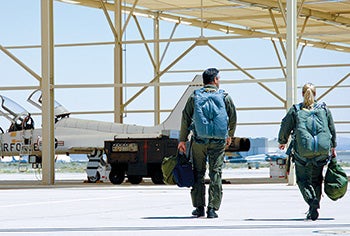
Air Force Test Center Flight Safety deputy chief Bill Koukourikos and Public Affairs specialist Laura Mowry approach their T-38.| There is always an edge, a place where what we know, the very best of our machine and our skill do not match what might happen, a place where “a wing and a prayer” holds operational […]

Read More »
Pilot in aircraft
Sign-up for newsletters & special offers!

Get the latest stories & special offers delivered directly to your inbox.

SUBSCRIBE