












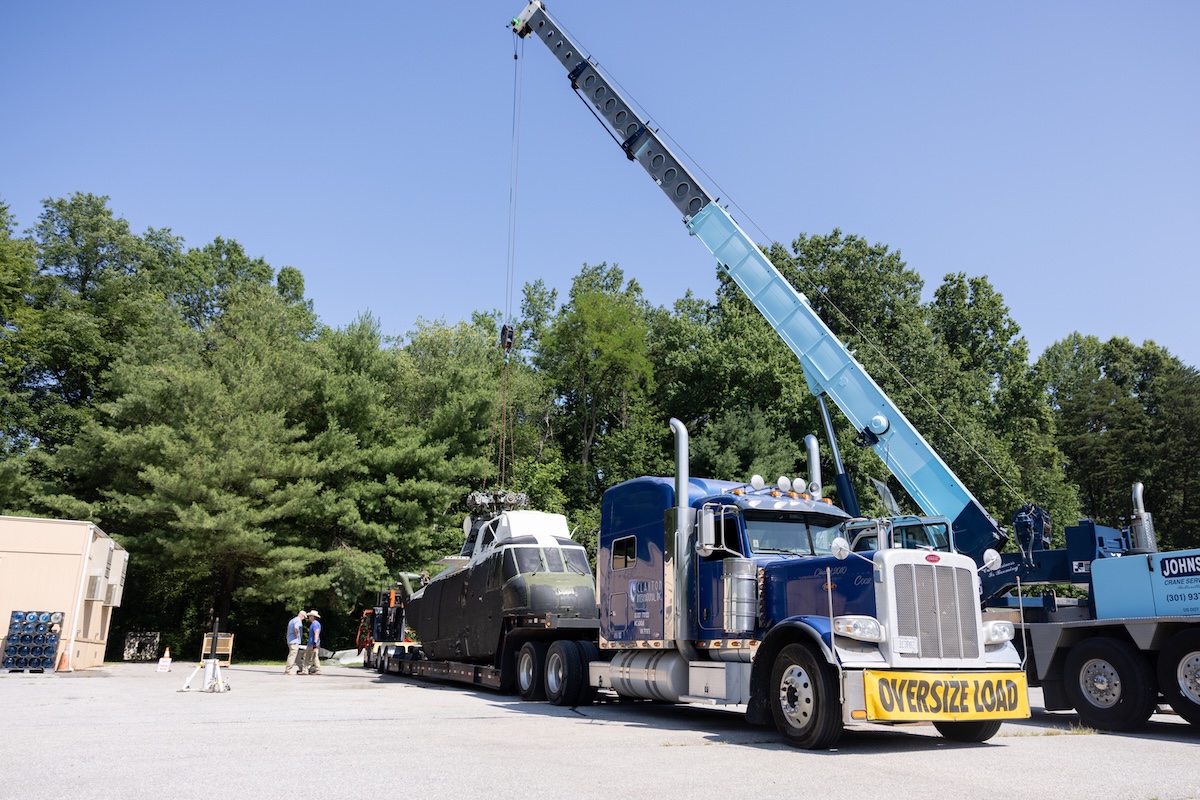


The U.S. Secret Service has recently acquired an authentic Marine One helicopter for its James J. Rowley Training Center (RTC) in Laurel, Maryland, enhancing protective training capabilities for agents preparing to safeguard the president and vice president.
Authentic Presidential Aircraft Enhances Training
The newly acquired VH-3D 351 model, which arrived June 24 on a flatbed trailer, represents a substantial upgrade from the aging helicopter previously used at the facility.
“Our existing aircraft had seen better days,” said Troy Sarria, deputy special agent in charge of the training center. “It was definitely an aging platform.”
The decommissioned helicopter has transported every president and vice president around the world over the past fifty years, making it a genuine piece of presidential and Secret Service history.
Unlike its predecessor, which was never actually used to transport presidents and had deteriorated significantly, this authentic Marine One platform offers agents realistic training conditions.
“The whole goal was to have an actual operational piece of equipment so that you can do real, live training,” said Michael Jazwiecki, deputy chief of the Secret Service’s Uniformed Division, who initiated discussions to acquire the helicopter nearly three years ago during a chance meeting with General Eric Smith, the Commandant of the Marine Corps.
Strategic Placement Enhances Protective Scenarios
The new helicopter’s placement at the training center strategically mirrors real-world protective scenarios. Positioned at the nose of the mock Air Force One training section (affectionately known as “Air Force One Half”), the helicopter allows agents to practice the complex choreography of presidential movements between aircraft—a common security scenario during presidential travel.
“For those agents going to the president’s or vice president’s detail, this provides a hands-on realistic training environment,” said Jaswicki, who coordinated with Colonel Rantham and lead maintenance officer Matt Cooper from the presidential helicopter program to secure the aircraft.
The helicopter’s interior configuration matches that of the president’s current VH-92 model, providing trainees with an accurate representation of the operational environment they’ll encounter in the field. This allows for training both inside and outside the aircraft—a significant improvement over the previous helicopter, which was limited to exterior training due to its deteriorated condition.

According to Sarria, the new helicopter will be used weekly in various protection training scenarios.
“We always have some sort of protection training going on here,” he said.
Beyond its training value, the helicopter also serves as an educational exhibit for visitors touring the facility.
“We also use this as an exhibit piece,” Sarria said. “We always stop by here and give them a demonstration on how protection works at airports, since we spend so much time at airports.”
The Presidential Helicopters Program Office gifted the helicopter to the Secret Service and covered the costs of shipping the new aircraft and removing the old one, which was transported to Arizona for recycling.

