
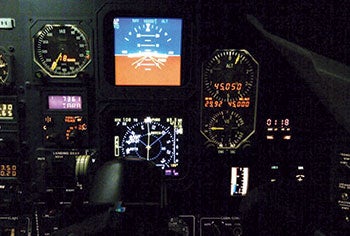


The moon seemed to take itself so seriously that it paid little attention to us. Though less than a quarter of its full self, it looked down with indifference at our little ship as it hurtled through the cosmos. This lack of concern was a boon, it turned out, for the low moonlight allowed the stars to come out, both above and below us. We were sailing through the heavens, or so it felt. The stars below us were brighter than those above. That was because they were oil rigs in the Gulf of Mexico, brightly lit in the dark night. That sprawling nebula to our far left was the whirl of lights marking New Orleans. It was a surreal sight; only the steady competence of the HSI with its over-lying map and the rock-solid airspeed indicator with its numerical announcement of .78 Mach brought some semblance of reality to the scene. That is, of course, if you are accustomed to flying in a Lear 31 at 45,000 feet over vast stretches of water in the dark. If that is your reality, then this would seem normal. For this new Learjet pilot, normal is not a word that comes to mind; remarkable is more like it.
A day in the life of a working Lear can be something to behold. Elite Air, for which I have had the privilege to fly occasionally over the past 16 months, operated this one. The first leg, an empty one, from St. Petersburg, Florida (KPIE), to Fort Myers (KRSW), was mine. I am getting better at taxiing and more precise at the callouts. In the car on the way to the airport, I reminded myself to announce “gear up, yaw damper on” when Capt. Jason Hepner said “positive rate” and to say “flaps up, afters” when he called 400 feet and V2 plus 20. I love the sound of these words, and I could not wait to say them. KRSW was landing on Runway 6 and, though the weather was clear, Jason set up the ILS as backup. For some reason, I got behind the glideslope, and it wasn’t until about 500 feet above the airport that I got it all together on speed and glidepath. The touchdown was good, though.