Register

Pilot Proficiency

Briefing: May 2018

Changes Follow Fatal Helicopter AccidentBoth the FAA and NTSB called for change after five people died in a helicopter accident in New York in March. They were flying in a Eurocopter AS350 with the doors off, a popular option for sightseeing flights, and were wearing special harnesses that were difficult to release. The helicopter lost power, and the pilot made an emergency landing on the East River. The aircraft then rolled over and sank. Only the pilot, who was wearing a different kind of harness, was able to escape. The FAA prohibited doors-off flights unless passengers have quick-release harnesses. The NTSB called on the FAA to prohibit commercial flights of all kinds that secure passengers without quick-release mechanisms.
Read More »

Readback May 2018

I was able to pull the ODP data but not the SID data, but I can give a fairly good guess as to whats going on. On the ODP, the controlling obstacle is a 2729-foot tower a few miles to the east of the runway. The initial climb is extended a bit more than usual in order to allow for a standard climb gradient when turning right (note that for turns other than to the right, a normal 400-foot turn is allowed). The WENDY and TRUPR are examples of Open SIDs, which have a route off the runway followed by radar vectors to a route. In these cases, the route off the runway is evaluated, but then the radar vector area gets no additional evaluation (other than MVA, etc.). SID evaluation begins again at the defined route. Because theres no SID evaluation required after the initial climb, the controlling obstacle for the ODP isnt considered. The minimum turning altitude for an RNAV SID is 500 feet above the runway, which would give you a turn at 1800 vs. the turn at 1900 on the ODP to keep a standard climb gradient and clear the tower. -LS

Read More »

Landing Losses

General aviation pilots are having problems landing their airplanes. According to the insurance industry, landing losses – accidents and incidents in which aircraft are damaged during the landing phase – continue to be a persistent issue. What’s going on here? Hang out at your local airport on a windy day and it won’t take long […]

Read More »

Why Preflight Preparation and Planning Pay Off Big Time

As a newly minted flight instructor in 2002, I thought I knew it all. I could recite regulations from Part 61 and 91 from memory and anticipate my students’ mistakes before they happened. I felt like my stick-and-rudder skills were at their peak, having just wrapped up the maneuvers training for the commercial pilot certificate […]

Read More »

The Tale of a Bonanza’s Run-in with Some Very Large Trees

Last Thanksgiving, instead of wrestling with turkeys and relatives (not necessarily in that order or degree of difficulty), I fibbed and told my family I’d be out of town. Actually, I’d accepted an invitation from friends who always throw a splendid “do” with a large and eclectic collection of family, friends and assorted “homeless” souls […]

Read More »

Even the Ancient Greeks Dealt with Turbulence

My mother, who fortified herself for any aerial voyage with either Miltown or Chivas Regal, would later revisit with perverse relish each “air pocket” the plane had encountered. I’m not sure what she believed an air pocket consisted of, but I suppose it was something like the “region of low pressure causing an aircraft to […]

Read More »

Flying In New Zealand Challenges an Airline Pilot

“You OK, Honey?” I asked immediately after the 172 had taken a respectable shot of turbulence. The Cessna responded with a quick 30-degree roll to the right before I could correct. After a second or two of silence, my wife replied over the intercom, “Yeah, I’m fine.” Even though she was seated directly behind me, […]

Read More »

How the Cirrus Combined Throttle/Prop Control Works

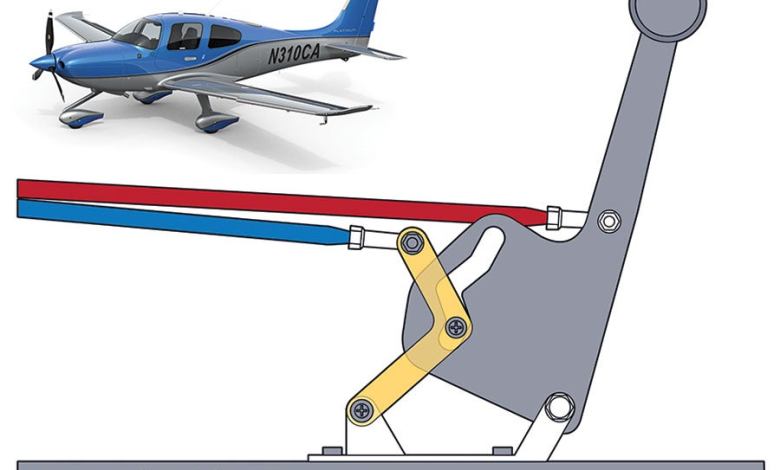
There’s something to be said for simplicity when teaching people to fly or merely checking out in a new aircraft. Simplicity was Cirrus’ motivation behind this month’s feature, the combined throttle and propeller control that’s standard on both the Cirrus SR20 and SR22. In complex aircraft, a throttle controls engine acceleration, while a separate blue […]

Read More »

Two Airplanes, Two Accidents

In July 1999, we departed Norfolk, Virginia (KORF) and headed northeast out over the Chesapeake Bay. It was a hazy day. The sky and the water were the same washed-out blue gray; there was no discernible horizon. I was flying our Cessna 340, my first twin. I’m guessing by that time I had about 2,500 […]

Read More »
Pilot in aircraft
Sign-up for newsletters & special offers!

Get the latest stories & special offers delivered directly to your inbox.

SUBSCRIBE