













NTSB Accident Reports-July 2024

A monthly summary of recently published NTSB preliminary accident reports involving general aviation and air carrier aircraft.

Screenshot
Gemini Sparkle

Key Takeaways:

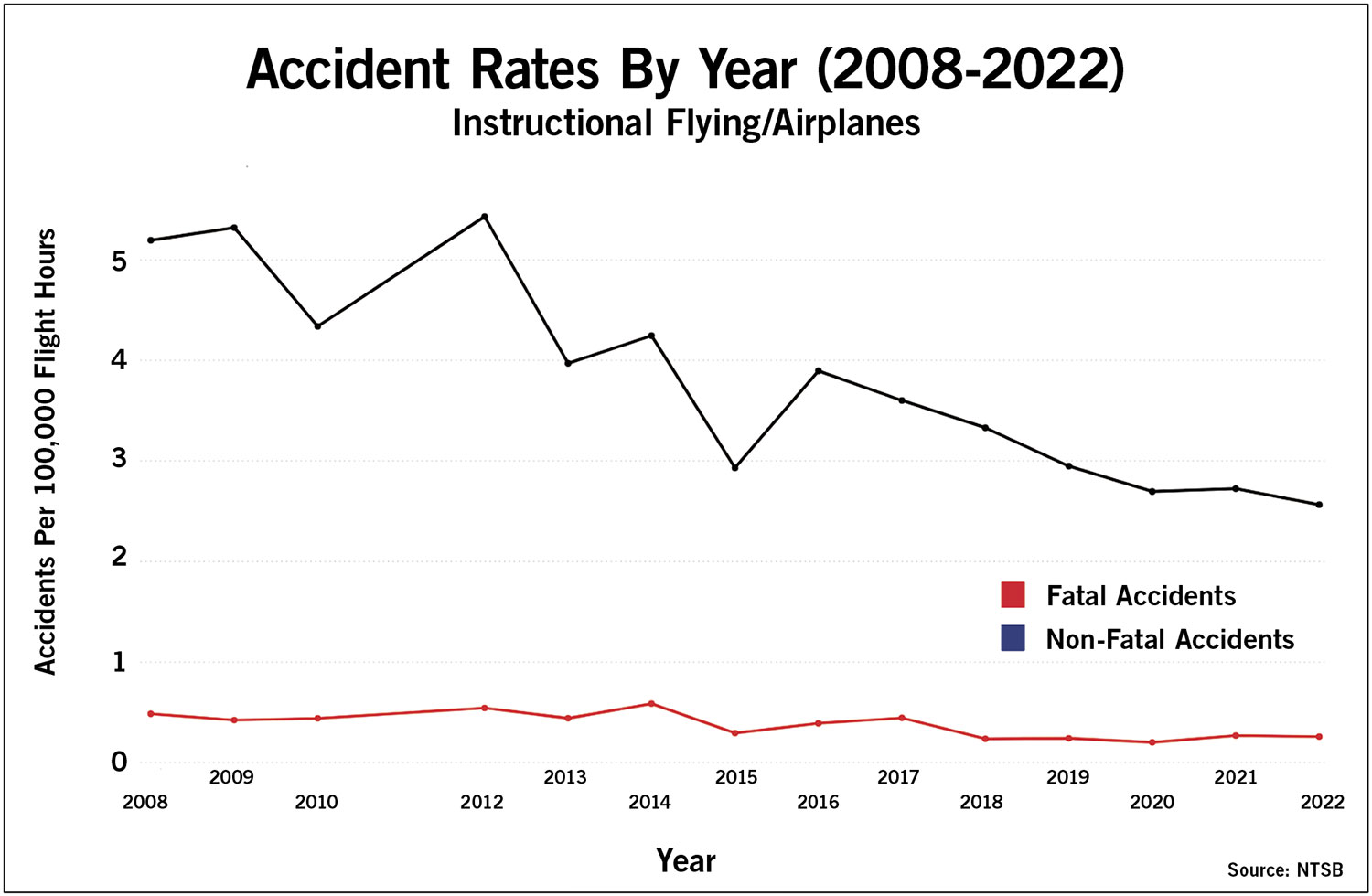
  • Accident rates for instructional flights show a substantial decline in non-fatal incidents from 2008-2022, but fatal accident rates have remained stagnant.
  • April 2024 saw numerous general aviation accidents with diverse causes, including engine failures, in-flight breakups, and loss of control during maneuvers.
  • Many of these April incidents resulted in fatalities or serious injuries to pilots, passengers, and, in one instance, pedestrians.
See a mistake? Contact us.

April 1, 2024, Muncie, Ind.

Piper PA-28-236 Dakota

At about 1027 Eastern time, the airplane was destroyed when it collided with terrain while maneuvering at the end of an instrument approach. The solo instrument-rated private pilot sustained serious injuries. Two pedestrians on the ground also sustained serious injuries. Instrument conditions prevailed.

Shortly after descending to 2900 feet msl (about 1950 feet agl) and aligning with the RNAV Runway 14 approach, the airplane appeared to track right of the final approach course and parallel it. Approximately at the midfield point abeam the airport and at about 200 feet agl, the airplane entered a climbing right turn before completing two 360-degree turns. The highest altitude obtained in the turns was about 600 feet agl before track data was lost at 1026 and 350 feet agl, when the airplane was on an approximate 292-degree ground track. The airplane impacted terrain about 3400 feet southwest of the midpoint of Runway 14. Recorded weather at the time included winds from 040 at 13 knots, visibility of six miles in mist and an overcast ceiling at 500 feet agl.


April 2, 2024, Mulberry, Fla.

Aeromarine Merlin Lite ELSA

The motorglider was substantially damaged at 1038 Eastern time when it collided with terrain shortly after its engine appeared to quit. The solo private pilot sustained fatal injuries. A witness reported the aircraft’s taxi and initial takeoff operations appeared normal until the engine “went silent” during initial climb. Surveillance video recorded the motorglider turned right and then to the left and then pitched up before the left wing dropped, and it began a near-vertical left rotating descent to terrain.

Examination of the accident site confirmed flight control continuity through multiple overload fractures from all flight control surfaces to the flight controls in the cockpit. Melted aluminum was found on the single-cylinder engine’s spark plugs. The cylinder head was removed, revealing a one-inch-diameter hole in the top of the piston.


April 2, 2024, Alpine, Ark.

Mooney M20E Super 21

At about 1056 Central time, the airplane was substantially damaged during an off-airport precautionary landing. The solo pilot was not injured.

 According to the pilot, while in cruise flight, both of the airplane’s  carbon monoxide (CO) detectors began alerting, and he felt symptoms of CO poisoning. The pilot closed the cabin vents, opened a small cockpit window and attempted to open the door, but was unsuccessful. The pilot decided to not continue the flight. Instead, he shut down the engine and performed a forced landing to a field, where it sustained substantial damage to the forward fuselage.


April 4, 2024, Bluff Dale, Texas

Bellanca 7KCAB Citabria

The airplane was destroyed at 2211 Central time after an in-flight fire erupted and the pilot executed an emergency nighttime off-airport landing. The solo pilot sustained minor injuries.

The pilot later reported he saw flames coming from the engine cowling’s oil access door while en route. The pilot shut off fuel to the engine and executed an emergency descent. He landed in a field 15 nm southwest of his destination. The pilot successfully egressed the airplane, which continued to burn and was destroyed by the fire.


April 8, 2024, Clarksville, Ark.

Temco D-16A Twin Navion

At 1410 Central time, the airplane was substantially damaged when its left engine reportedly failed shortly after takeoff and it collided with trees. The pilot and three passengers were seriously injured.

According to the pilot and passengers, the takeoff seemed normal until they were about 100 feet agl. At that time, the airplane began to roll to the left and the pilot said the left engine had failed. The airplane continued to roll left and impacted trees, damaging the wings, empennage and fuselage.


April 11, 2024, Auburn, Wash.

Cessna P210N Pressurized Centurion

The airplane was substantially damaged at about 1345 Pacific time when its right main landing gear collapsed shortly after landing. The solo pilot was not injured.

The pilot reported that the airplane’s annual inspection had just been completed and he was conducting a systems check, including landing gear extension, in the local practice area. He put the gear selector switch in the down position, but the indicator lights did not illuminate, although he could hear the hydraulic pump operating. The pilot cycled the gear but did not receive a gear-down indication. He also used the emergency gear extension hand pump, noting marginal resistance. During a low-level fly-by, a witness reported the landing gear appeared to be fully extended. While rolling out after landing, the right main landing gear collapsed. The airplane veered to the right side of the runway, striking a runway sign and a light, before coming to rest.


April 12, 2024, Knoxville, Tenn.

Piper PA-32R-301 Saratoga SP

At about 1633 Eastern time, the airplane was substantially damaged when it broke up in flight before colliding with terrain. The solo commercial pilot was fatally injured.

After takeoff, ATC cleared the pilot to 10,000 feet msl and the airplane began climbing on course. During the climb, the pilot reported the airplane was accumulating “moisture.” Shortly thereafter, the pilot declared a “MAYDAY” as the airplane began to descend from an altitude of 8500 feet msl. Tracking data indicated an abrupt left turn of about 90 degrees, followed by a clockwise spiraling descent. The airplane’s groundspeed increased rapidly until track data was lost at about 1634, approximately 15 nm from the departure airport.

A witness observed an airplane “falling out of the sky, twirling” and descending below the clouds. He then heard “parts hitting the ground” nearby, which turned out to be the airplane’s vertical stabilizer and rudder. The wreckage was dispersed over a two-mile area. The stabilator was broken in two pieces and located about 1.5 miles from the main fuselage. The left wing was separated from the fuselage at the wing root and located about a mile from the main wreckage.


April 16, 2024, Hartsburg, Mo.

Piper PA-46-350P Malibu Mirage

The airplane was destroyed at about 1205 Central time when it broke up in flight before impacting the ground. The solo pilot was fatally injured.

The flight departed Madison, Wis., at about 0951 and proceeded to its destination in Arkansas at 16,000 feet msl until 1149, when it turned south-southeast, and then to the south a few minutes later. At 1204, it entered a descending left turn calculated at more than 16,000 fpm. The airplane’s fuselage came to rest about 0.14 nm north of the last recorded position of the airplane.

The main wreckage consisted of the airplane’s fuselage, which came to rest on a wooded hillside next to a pasture. On-site evidence suggested a near-vertical impact with terrain. The inboard four feet of each wing remained attached to the fuselage. The tail surfaces and both outboard wings had separated from the airplane. The wings, elevator, vertical tail and the rudder were located along a line extending from the fuselage on a 018-degree heading for about 3.1 nm. The farthest piece of wreckage located was the vertical tail, with the other pieces between the fuselage and the vertical tail. The horizontal tail pieces were not located.

A review of weather data revealed that a convective Sigmet had been issued for the area including the accident site and was valid at the time of the accident. The Sigmet warned of areas of severe embedded thunderstorm activity, with tornadoes, hail up to two inches in diameter and wind gusts of up to 60 knots.


April 22, 2024, Spicewood, Texas

Lancair Legacy FG

At about 1826 Central time, the airplane was destroyed when it collided with terrain after its pilot apparently lost control during a second landing attempt. The solo pilot was fatally injured.

A witness reported the first landing approach was “fast” and the airplane “ballooned.” The pilot conducted a go-around. On the second approach, the witness heard the engine increase in power and the airplane began to climb “straight up,” yawed to the left and then went “straight down.” Portions of the airframe were consumed by a post-impact fire. All major components of the airplane were present at the accident site.

The propeller was impact-separated from the engine. Both propeller blades exhibited chordwise abrasions, leading edge gouges and longitudinal twisting. Torsional deformation was noted to the propeller spinner.


April 23, 2024, Fairbanks, Alaska

Douglas C-54D Skymaster

The airplane was destroyed at about 1003 Alaska time when its #1 engine caught fire and separated from the left wing shortly after takeoff. The airplane then experienced an in-flight explosion before colliding with terrain. The two pilots were fatally injured. The airplane was transporting 3400 gallons of unleaded gasoline and two 100-gallon propane tanks.

Shortly after takeoff, the pilot told ATC there was “a fire on board” and that they needed to return. A witness observed the airplane flying with its #1 engine not running and trailing white smoke, and then fire. Surveillance video then showed a bright white explosion just behind that engine, followed by fragments of airplane wreckage falling to the ground. The airplane then began an uncontrolled descending left turn into terrain. The #1 engine separated from the wing at about 100 feet agl and came to rest on a frozen river. A large post-crash fire ensued, which incinerated much of the airplane’s structure.


April 23, 2024, Placerville, Calif.

Cessna T210L Turbo Centurion

At 1113 Pacific time, the airplane was substantially damaged when it departed the runway after landing and collided with an unoccupied airplane and a hangar. The pilot and passenger were not injured.

The pilot reported that, immediately after touchdown, the airplane veered right. He attempted to correct with left rudder input along with left brake application, but the airplane continued to the right, exited the runway and impacted an the airplane and hangar. The pilot later examined the right wheel assembly and found it would not move on the axle.


April 24, 2024, Raleigh, N.C.

Socata TBM 850

The airplane was substantially damaged at about 1010 Eastern time when it collided with terrain during an apparent attempted go-around. The airline transport pilot was seriously injured; the passenger received minor injuries.

Preliminary reports from ATC reveal the airplane was cleared to land, and then bounced on the runway before it “began a missed approach and started a left turn…then appeared to have stalled and hit the ground.” Surveillance videos and photographs show the airplane impacting the ground with its left wingtip and nose almost simultaneously.


April 30, 2024, Bristol, Ind.

Zenair CH 601 HDS Experimental

At 1418 Eastern time, the airplane was destroyed when it apparently descended from cruise out of control before striking terrain. The private pilot and pilot-rated passenger were fatally injured.

According to ADS-B data, the airplane took off on the accident flight at 1339. It cruised at 4500 feet msl and a true airspeed of about 80 knots for the 44 nm flight. At 14:15:44, the airplane started a descent and continued toward its destination. During the next two minutes, true airspeed increased to about 110 knots and the average descent rate was about 600 fpm. At 14:17:44, the descent steepened: airspeed increased to about 120 knots and the descent rate exceeded 7000 fpm. The final data point was recorded at 14:18:05 at 1836 feet msl (1072 feet agl). The airplane’s position was seven nm from its destination and about 400 feet east of the accident site.

A witness observed the airplane descending straight down and did not see any smoke or fire coming from it. The engine was very loud and continued to operate until the impact with terrain.

Ready to Sell Your Aircraft?

List your airplane on AircraftForSale.com and reach qualified buyers.

List Your Aircraft
AircraftForSale Logo | FLYING Logo
Pilot in aircraft
Sign-up for newsletters & special offers!

Get the latest stories & special offers delivered directly to your inbox.

SUBSCRIBE

