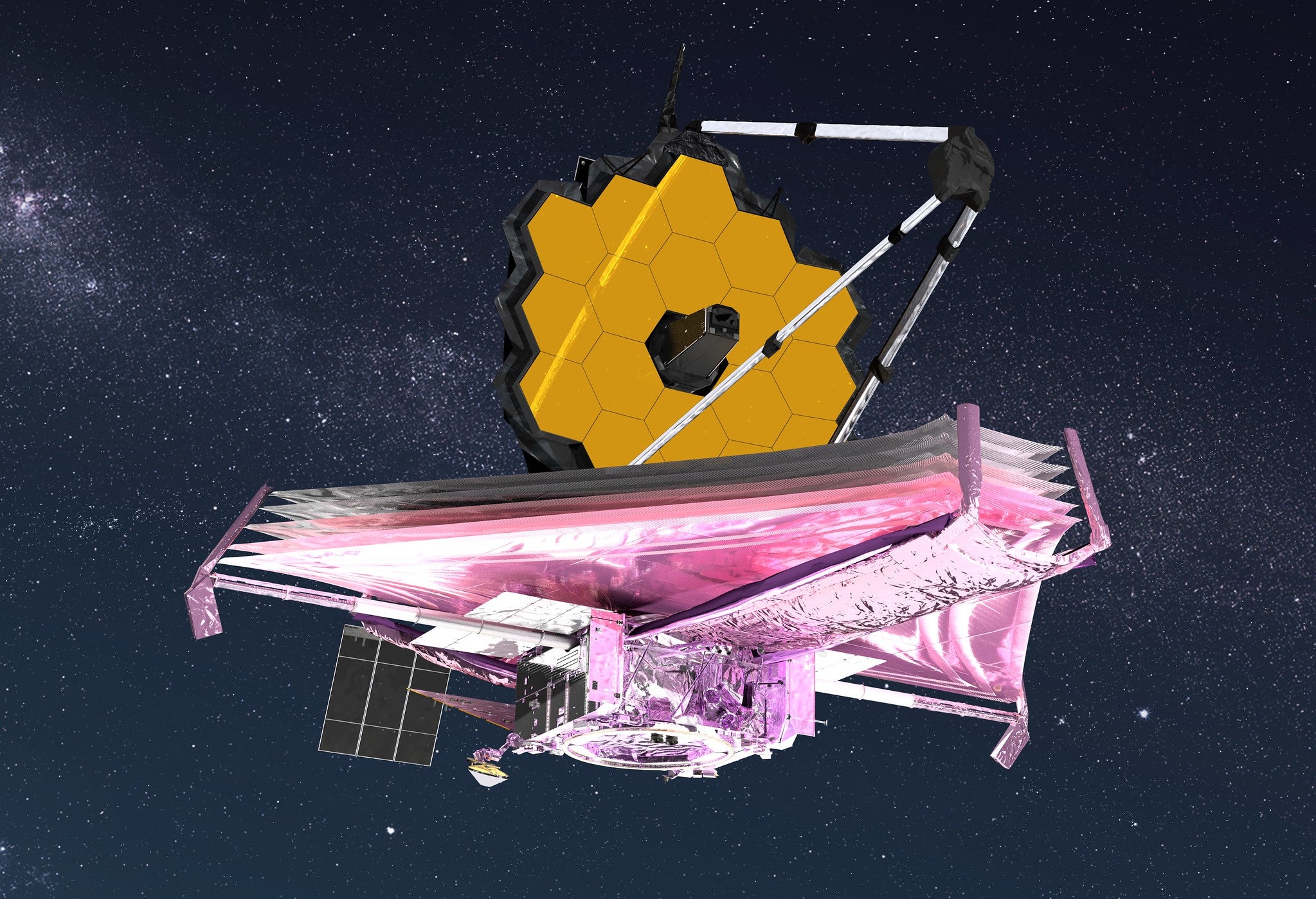
The long-awaited James Webb Space Telescope has reached its final destination after a month-long journey, 1 million miles away from Earth, to peer into the moments shortly after the Big Bang.
Artist conception of the James Webb Space Telescope. [Credit: NASA GSFC/CIL/Adriana Manrique Gutierrez]
Key Takeaways:
The James Webb Space Telescope successfully reached its final destination, the second sun-Earth Lagrange point (L2), approximately 1 million miles from Earth, after a month-long journey and a final course correction burn.
Its placement at L2, coupled with its sunshield, allows the telescope to operate without interference from the sun, Earth, and moon, enabling its mission to peer into the early universe.
Before it can begin capturing images (expected this summer), Webb's instruments must cool to extremely low temperatures, and its mirrors will undergo a precise three-month alignment process.
The long-awaited James Webb Space Telescope has reached its final destination after a month-long journey, 1 million miles away from Earth, to peer into the moments shortly after the Big Bang.
Monday afternoon, Webb fired its onboard thrusters for nearly five minutes to perform its final course correction to its orbit around the second sun-Earth Lagrange point, known as L2.
CREATE A FREE ACCOUNT
Sign up to keep reading
Create a free account to continue. Already a member? Sign in below.
Jeremy attained his bachelor's in journalism and emerging media from Kennesaw State University. He also served in the Georgia Air National Guard as a C-130 Crew Chief for six years, holding an associate in aircraft maintenance technology.