Readback

Readback: October 2019

First, we checked with Garmin and their equipment actually decodes the Morse code identifier rather than rely on GPS and the tuned frequency to look it up in the boxs database. So far, so good. We next checked with Mark Kolber, our regs guru, and he pointed us to AIM 1-1-3.c. That paragraph talks about navaid identification in general, pointing out that merely hearing Morse code isnt enough because it could be transmitting TEST. Likewise, live voice transmissions from FSS or ATC dont indicate a valid navigation signal. The prize, though, is in the paragraphs last sentence, If your equipment automatically decodes the identifier, it is not necessary to listen to the audio identification. So, Rick, youre right. If the box decodes and displays the Morse code identifier, you can rely on that.
Read More »

Readback: September 2019

Im so glad you tackled the question of whether it is a requirement to report leaving an altitude. I read the regs years ago and have continued to report leaving on every altitude change but I often feel I am alone or perhaps one of a small minority. Ive gone back and reviewed the regs again to see whether I was doing it incorrectly since I wasnt hearing many others doing so and it does take more air time to say, …leaving flight level 240 descending flight level 200 than 200, when cleared from FL240 to FL200, for example.

Read More »

Readback: August 2019

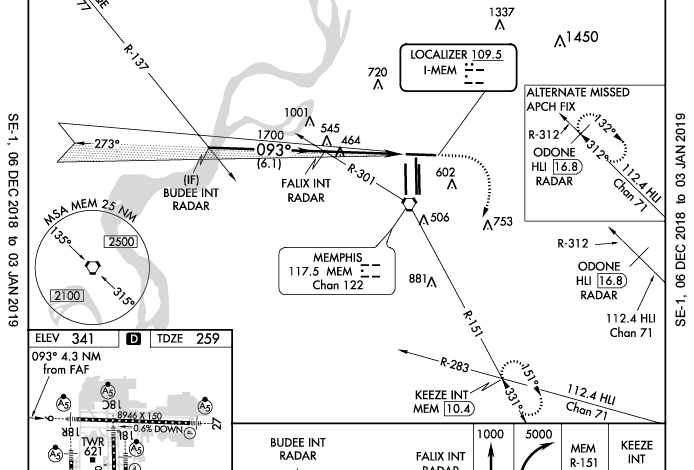
In the Report Leaving article in February, the approach clearance with a vector to FALIX did not include a descent. Many years ago, I was taught to stay at the last assigned altitude until established on a published route. In this case, I guesstimate that you would have only a couple of miles, at best, to lose 1300 feet after intercepting the localizer.

Read More »

Readback: July 2019

We got a quick response from Garmin. Its actually a bug in the underlying approach data, but that apparently ongoing bug is now handled by the navigators operating software. The reported issue doesnt have anything to do with database capacity. The issue began when some IAPs with LP lines of minima were coded with a Vertical Descent Angle (VDA) of 0 degrees. Software did not expect this as the IAPs are not supposed to be coded with VDA=0. If the IAP has no VDA (noted as Decent Angle NA on the chart), then the navigator can fly the approach as an LNAV-only without vertical guidance. If the IAP is coded with a VDA of zero, Garmin makes the approach unavailable from the database. Later software corrects this anomaly and restores the IAPs with VDA=0. Note that there was a Service Advisory Garmin sent out in 2013 when the issue was identified and they started to filter the affected IAPs from the Navigation database.

Read More »

Readback: June 2019

The nit is with one of the parts of the answer to Question 11. As the answer to question 3 says, our minimum descent altitude for this approach is 1100 feet, but thats MSL. (Basic minimum for the LOC-7 approach is 1000 MSL, to which we added the required 100 feet for remote altimeter.) As the chart says, that 1000 MSL translates into 611 feet above the touchdown zone elevation of 389 feet, so 1100 MSL is 711 feet above TDZE (and 703 feet above airport elevation).

Read More »

Readback: May 2019

The number is (650) 446-6777. Just text the word METAR or TAF followed by the ICAO airport identifier of interest and youll quickly get a reply with the requested information. Even international airports are available. If you want to get hourly updates, you can subscribe (for free) by putting SUB first in your text message. Thus, to get hourly METARS, for instance, for Walla Walla, WA, (KALW) youd text SUB METAR KALW until you no longer wanted them and sent STOP METAR KALW.

Read More »

Readback: April 2019

Dan, we believe that the appeal of our annual SPT article (every January) is that most of us can find one or more examples cited in the article where we can easily imagine ourselves as the pilot, except we escaped unscathed. So, much of that laughter is laughing at ourselves. Statute of limitations or not, there are many antics I got away with that Ill never, ever admit to in public. Or, as an aerobatic pilot I once knew who couldnt avoid practicing low over somewhat populated areas used to like to say, I wasnt there. It wasnt me. You cant prove a thing! -FB

Read More »

Readback: March 2019

The answer to Question 5 in your December Quiz says, Circling approaches require left-hand turns unless the approach procedure explicitly states otherwise. Is this still a true statement when the runway youre landing on is published right traffic? Ive found that the AC and the regs dont address this clearly. I believe that the intent is that the required direction of turns is in accordance with the published traffic pattern (absent requirements to the contrary on the approach procedure), but Ive been unable to get a satisfactory answer.

Read More »

Readback: February 2019

I thought your Remarks, Pilot Shortage? in October were very well said, sir. I just retired after 40 years of airline flying. Like most, I started as a CFI before the airlines ($15 dual/wet) before getting hired as a Twin Otter F/O and then Captain making $1700/month flying about 50 hours per month. I finished as an International Heavy Jet Captain making in the mid $300K per year but still hourly but with better work rules. In reality the wages havent gone up that much when compared with the astronomical costs to get the ratings.

Read More »

Readback: January 2019

Another good rule of thumb is Buys Bullots law: To locate where the bad weather is coming from, put your back to the wind and extend your left arm straight out. Thats where the low pressure bad WX is coming from. It works for me.

Read More »
Pilot in aircraft
Sign-up for newsletters & special offers!

Get the latest stories & special offers delivered directly to your inbox.

SUBSCRIBE