












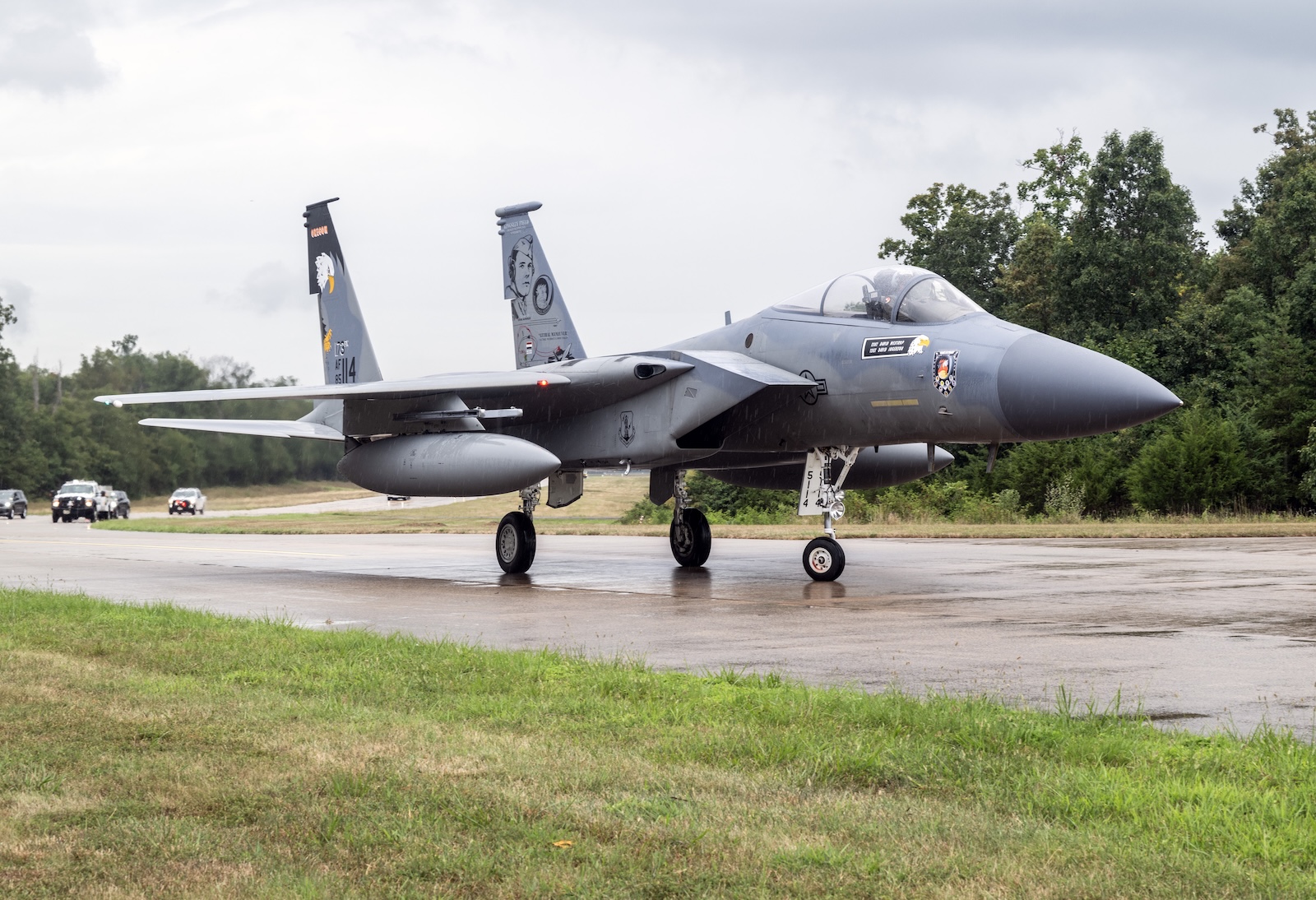


The Smithsonian’s National Air and Space Museum has officially accepted a McDonnell Douglas F-15C Eagle into its collection, marking the first time this iconic fighter aircraft has been accessioned by the institution. The aircraft arrived on Wednesday at the museum’s Steven F. Udvar-Hazy Center and is expected to be on display in the coming weeks.
Michael Hankins, modern military curator at the museum, described the F-15C as “one of the most iconic American fighter aircraft of the last 50 years,” highlighting its significance in post-World War II aviation history.

The F-15C is a U.S. Air Force air superiority, all-weather fighter optimized for air-to-air combat. It achieves a maximum speed of Mach 2.5, and no F-15 Eagle has ever been downed in air-to-air combat, while pilots flying the type have recorded over 100 aerial victories.
This particular F-15C carries a distinguished combat legacy.
While flying this aircraft, then-Captain Cesar “Rico” Rodriguez achieved two aerial victories against Iraqi MiG fighters during Operation Desert Storm in 1991, as part of the 58th Tactical Fighter Squadron of the 33rd Tactical Fighter Wing. Rodriguez later scored a third victory—a MiG-29—during Operation Allied Force in 1999, flying a different F-15. He is among only four Americans since 1972 to achieve three aerial victories, placing him closest to “ace” status among post-Vietnam-era U.S. pilots.

The aircraft was flown in and taxied directly to the Udvar-Hazy Center after arriving at Washington Dulles International Airport (KIAD), which is adjacent to the museum.
Still Flying
A few F-15s are on display in museums, including one at the National Museum of the United States Air Force in Dayton, Ohio.
Roughly 1,000 F-15s are in service worldwide. The U.S. still flies around 350, including the F-15C/D, F-15E, and the new F-15EX variants. Japan, Israel, and South Korea are among the other countries also using the aircraft.

