














Register

Elon Musk’s Tesla Spotlights Call for Transparency in Operating Craft in Deep Space

While objects in low Earth orbits are tracked by the U.S. Space Force, deeper space remains an unregulated frontier.

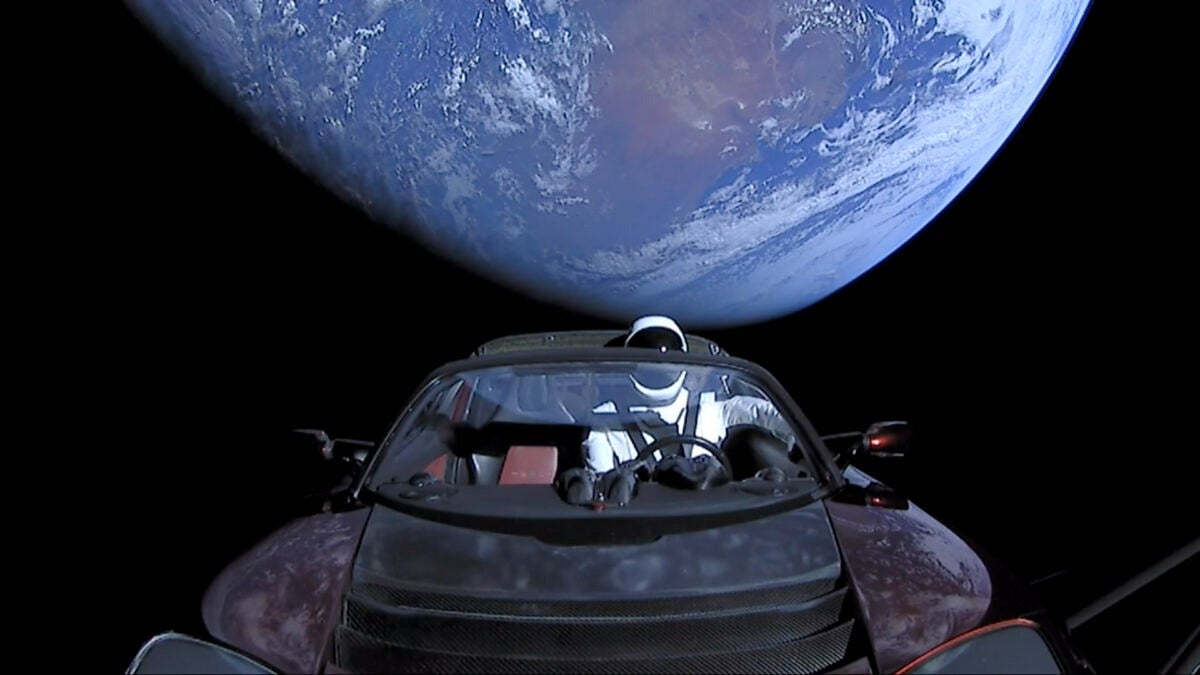
That’s no asteroid. That’s … a car? [Credit: SpaceX]
Gemini Sparkle

Key Takeaways:

  • The Minor Planet Center (MPC) mistakenly identified Elon Musk's Tesla Roadster, launched into deep space in 2018, as a new near-Earth asteroid before quickly retracting the designation.
  • This incident highlights a growing concern among astronomers regarding the lack of transparency and tracking for artificial objects (like spacecraft and rocket stages) in deep space, unlike those in lower Earth orbit.
  • Astronomers warn that untracked deep-space objects lead to wasted observation efforts, potential misidentification of asteroids, and could hinder planetary defense or scientific missions.
  • There is a strong call from the astronomical community for a centralized, public repository of deep-space object trajectories, regularly updated by national and private space agencies, to address this issue.
See a mistake? Contact us.

On January 2, the Minor Planet Center at the Harvard-Smithsonian Center for Astrophysics in Cambridge, Massachusetts, announced the discovery of an unusual asteroid, designated 2018 CN41. First identified and submitted by citizen scientist H. A. Güler, the object’s orbit was notable: It came less than 150,000 miles (240,000 kilometers) from Earth, closer than the orbit of the moon. That qualified it as a near-Earth object (NEO)—one worth monitoring for its potential to someday slam into Earth.

But less than 17 hours later, the Minor Planet Center (MPC) issued an editorial notice: It was deleting 2018 CN41 from its records because, it turned out, the object was not an asteroid.


Mark Zastrow

Mark got his bachelor’s degree in astrophysics from the University of Minnesota and master’s degrees in astronomy and science journalism from Boston University. At BU, he researched topics ranging from Jupiter’s magnetosphere and Enceladus’ plume to stellar activity on M dwarfs and the migration of hot Jupiters. Before joining Astronomy, he freelanced in Seoul, where he covered stories including AlphaGo’s victory, air pollution, dog cloning, research misconduct, and the MERS and COVID-19 outbreaks. He was also the science contributor for tbs eFM’s This Morning, the flagship news program on Korea’s largest English-language radio station, and editor of a South Korean politics newsletter from Korea Exposé. Mark lives in Milwaukee with his fiancé, Katelyn, and their two Jindo mixes, Gguri and Ahto. Mark is a licensed pilot, though these days, you’ll find him in his free time hiked out on his Laser sailboat on Lake Michigan or on the hill between turns 5 and 6 at Road America cheering on his beloved Indy cars.

Ready to Sell Your Aircraft?

List your airplane on AircraftForSale.com and reach qualified buyers.

List Your Aircraft
AircraftForSale Logo | FLYING Logo
Pilot in aircraft
Sign-up for newsletters & special offers!

Get the latest stories & special offers delivered directly to your inbox.

SUBSCRIBE
