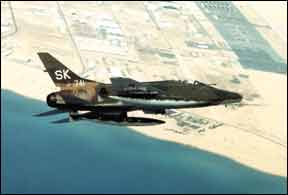
My older brother, Vincent, flying the big airplanes for TWA, had an easily remembered but profound saying: “check and doublecheck.” Basically, it meant to make sure all actions in the cockpit were given a second, or even a third, look, ensuring the proper actions had indeed been made. I vividly remember an occasion when that saying saved my life. I was flying an F-100 on a test mission out of Eglin Air Force Base, dropping some experimental high explosive bombs. One of the bombs did not drop, even though I had sent the release signal. The result was a very hazardous condition, called a “hung bomb.” The bomb might fall off at any time.
The article emphasizes the crucial aviation safety principle of "check and doublecheck," introduced by the author's brother and vital during an emergency landing with a "hung bomb."
While preparing for an emergency landing, the pilot's intuition sensed an incorrect aircraft attitude, despite visual indicators suggesting the landing flaps were down.
A physical "doublecheck" using touch revealed the flaps were, in fact, up, preventing a potential stall and highlighting how the mind can sometimes "see what it wants to see," underscoring the need for multiple verification methods.
My older brother, Vincent, flying the big airplanes for TWA, had an easily remembered but profound saying: “check and doublecheck.” Basically, it meant to make sure all actions in the cockpit were given a second, or even a third, look, ensuring the proper actions had indeed been made. I vividly remember an occasion when that saying saved my life.
288
CREATE A FREE ACCOUNT
Sign up to keep reading
Create a free account to continue. Already a member? Sign in below.