



There are two options when creating a larger footprint for a structure. You can either build out, as the buildings that dot large swaths of sprawling suburbia typically, or you can build up.
Vertical construction is rarely utilized at airports, though, with most hangars stretching side by side across formerly vacant land.
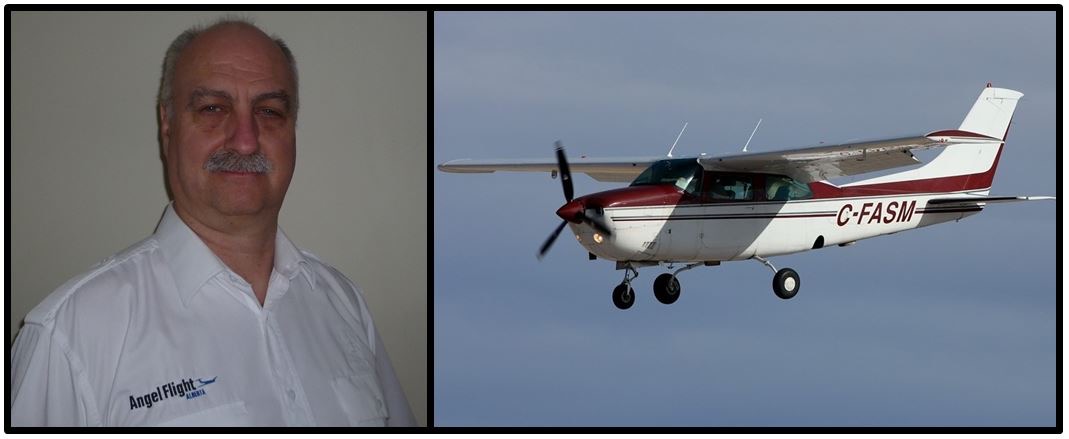
Barton Pawluski, an aircraft owner from Edmonton, Alberta, has developed a unique solution for remedying hangar shortages at airports with odd layouts or minimal room for new construction.
Throughout the course of his decades-long career as a mechanical engineer, Pawluski has developed novel products in several sectors, including oil and gas, medical, and agriculture.
“I’ve been employed in a lot of different industries, and oftentimes the things that were being sold by the company I was working for hadn’t been done before,” Pawluski said. “My thoughts about hangars turned into an R&D project.”
Pawluski’s “aircraft carousel” idea came from his own experience of his airplane being hit by ground equipment while parked at a seemingly calm and safe portion of the airport.
“[My brother and I] had a hangar on the farm, well actually a 50-foot-long-by-50-foot-wide building, where we were looking at how airplanes could be stored over the winter,” he said. “So, I started playing around with the movement of the airplane to see how the tails move, wingtips need to be positioned to avoid obstacles, and so on. From there, I decided there didn’t seem to be a lot of places that you can get a hangar where you’re not going to be worried about hangar rash.”
Pawluski then advised that aircraft stored in communal hangars follow an almost universal rule. Those that fly the most are stored at the front, and those sitting more often gradually find themselves shoved out of the way in the back.
So he thought: Why can’t every plane be as easily accessible as the next, while simultaneously being out of harm’s way of other aircraft tenants?
“How do you make a product that will allow everybody to have the security of their own space, without having to have two or three people move other planes in and out?” he said. “That’s how the concept initially came about, and then I started doing some work to find out about other products that may be out there already. There are others in the States who have filed other patents for various storage devices, including multistory ones. Then there was someone that was someone in Germany, that by the looks of it, had built one in Malaysia that had a scissor lift in the front and rotating disks. But the hangar had to be larger to accommodate the lift.
“There was another design that consisted of a set of linked frames that rolled on top of the hangar floor. The frames would be rotated until aligned with the hangar door, and then an aircraft could be rolled off of, or onto, the frame. The linked frames then could be rotated to the next airplane spot that was going to be loaded or unloaded. There are also designs that have a section of the hangar floor that is either a complete disk or a ring that rotates.”
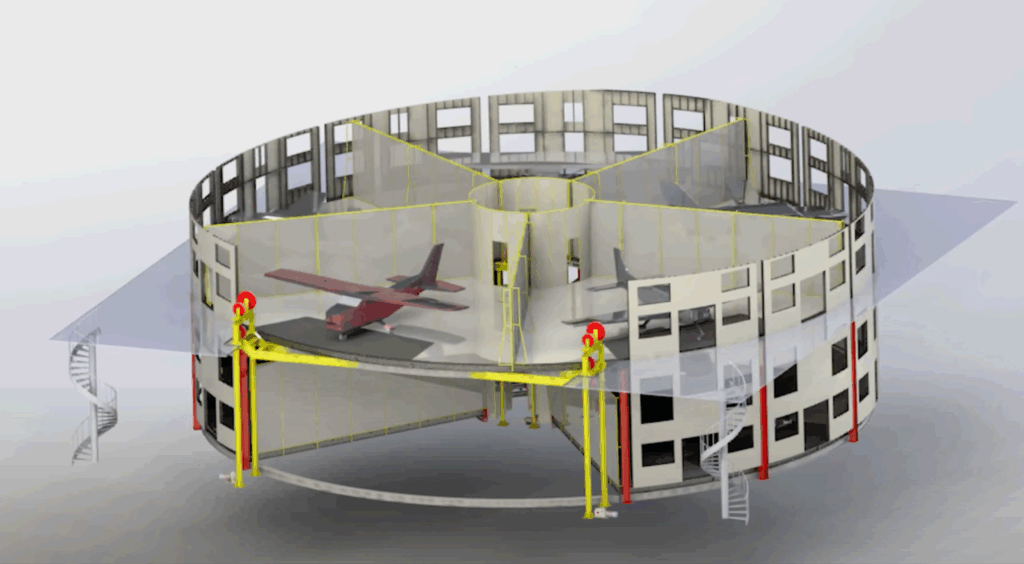
There is a video that showcases the end result of Pawluski’s work toward designing a two-story airplane carousel. So what makes his concept unique from others?
“The most important feature that I believe this design provides is the fact that the individual compartments are completely secured,” he said. “As there are only fixed positions for the lower level to align with the bifold door, and the same fixed positions for the upper level to align with the lift, the fixed outer perimeter walls can provide computer-controlled access doors to each compartment. This ensures the privacy and security of each compartment. Motion-activated cameras can notify owners when the carousel is in use, and the owners can live-view their compartment or the common areas within the hangar.”
- READ MORE: Minnesota Airpark Now Open for Business
With a commercially viable product developed, where does the northern aviator see a market opportunity for this aircraft vending machine?
“Where I live in Canada there is a lot of wide-open space around the airports where people are free to build hangars,” Pawluski said. “So, there’s not an appetite here, seemingly, for something that is more complicated. I need an airport that has limited space and a long waiting list for hangar space.”
Pawluski noted that there is also the possibility of having fractional or condominium-style ownership with his design.
“I’ve come across an airport in our neighboring province [in Canada] and found that there is some available land, however it’s not owned by the airport,” he said. “I’m in the process of
seeing if I can generate some interest there. What is great is that with this technology, people who want to hangar their airplane can come and go at whatever time, and you don’t have to have staff available to push it out of the hangar. It’s almost like a vending-machine-style storage solution for tenant or transient airplanes.”
FBOs are a potential customer base for this technology. The convenience of pushing a button for your aircraft could be further amplified by the fact it’s no longer susceptible to transport during tow operations and waiting for a line crew.
“If you had one of these hangars, you could either charge monthly rent to a single aircraft, sell a spot to multiple aircraft that come and go, or have it as a rental property for visiting aircraft,” he said. “I designed it so that you have a compartment that you are the only one to have access to, and that’s where I came up with the term ‘owner-only access.’”
Pawluski plans to continue refining his design and showcasing it as a unique solution to fight the pervasive problem of there not being enough hangars.
“I did start to go through the process of getting a patent,” he said. “The primary examiner had felt that this had been done by previous patents. However, we felt that this did not account for the differences that the compartments are secured and can individually move. I believe that the other patents have been abandoned, meaning that no one is interested in continuing to pay the annual patent fees to protect their ideas.”
There are three areas of the aviation industry where Pawluski sees opportunity for the two-story aircraft carousel to be adopted: FBOs, real estate investors/developers, and private builders.