










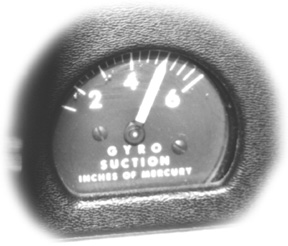
Living with Vacuum
Your gyros need more than a vac pump. Keep the system healthy and your instruments will often tell you when troubles afoot

Your gyros need more than a vac pump. Keep the system healthy and your instruments will often tell you when troubles afoot
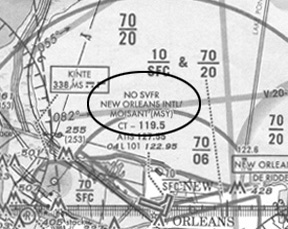
Special VFR gives you the option to land or take off when the weather is down, but the price is higher risk
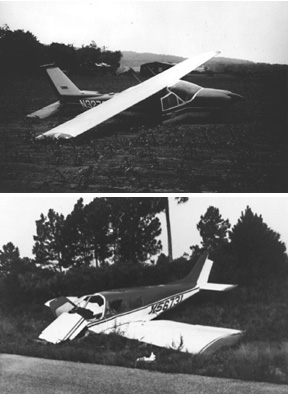
If an accident is imminent, orient the impact forces so your body is in the best position to cope – and then ride it out
I have approximately 1,600 hours as a private pilot, with about 400 hours IFR. I was still a little concerned about a recent IFR flight from the East Coast to Nashville in my Saratoga.
The weather at point of departure was overcast and windy, with no Pireps of tops, and a front was rapidly passing through the area. The western Carolina Mountains can pose some interesting and difficult problems for low-level flight, VFR or IFR. The forecast for later in the evening was clear.
I departed IFR in the early afternoon and broke out into the clear above 7,000 as I climbed to 10,000. The winds were strong and out of the west, but I encountered no significant turbulence en route to Nashville….
Over the water, in the clouds and flying partial panel – was this nuts or what?
The following information is derived from the FAAs Service Difficulty Reports and Aviation Maintenance Alerts.
———-
Some operators of aircraft with Lycoming -540 series engines who were hit by a pair of crankshaft bolt ADs last year got another letter from the FAA: Never mind.
The emergency AD and the superceding AD issued in December required owners of Lycomings big six-cylinder engines to replace the crankshaft gear retention bolt. The AD cut across applications, applying to aerobatic engines, turbos, left-turning engines and for airplanes and helicopters. Although it applied only to those engines with a Lycoming part number STD-2209 retaining bolt, many people didnt mak…
The article Alternate Realities [Airmanship, January] left out probably the most important and least understood criteria for alternate airport selection. Mr. Veillette starts out talking about the ceiling and visibility requirement of 600 and 2 for precision approach and 800 and 2 for non-precision approach equipped airports, and goes on to say that there is more to it than that. Unfortunately, he then goes on to only explain half of the remaining equation – the most important and most overlooked part.
In the authors explanation he is referring to the government charts, not Jeppesen. The government charts use the A in the triangle to define IFR Alternate Minimums. First, you must c…
At 1545 eastern time, a Taylorcraft BC12-D crashed after an inadvertent stall/spin while maneuvering. The pilot reported minor injuries and the passenger reported no injuries. The pilot said he was maneuvering at 500 to 800 feet agl on a deer-spotting mission when he stalled the airplane during a left turn at 500 feet. The airplane entered a spin, which he recovered, but he did not have enough altitude to arrest the descent. The airplane crashed into heavy brush at nearly a level attitude….
At about 1440 eastern time, a Cessna 182D crashed during a missed approach in New Philadelphia after the pilot reported the airframe icing up. The pilot and passenger were killed. The pilots weather briefing included reports of forecast icing conditions, pilot reports of icing conditions and advisories of low clouds and instrument meteorological conditions over a wide area along the pilots route of flight. The pilot then filed an IFR flight plan. As the airplane was vectored for the descent and VOR-A Approach to Harry Clever Field, the pilot reported that he was picking up moderate ice. The pilot was asked if he needed to change altitude and climb back to 4,000 feet. The pilot replied, …..
At about 1610 mountain time, a Cessna T210L made a precautionary off-airport landing after experiencing smoke in the cockpit. The airplane was destroyed during the ensuing crash sequence, but the two occupants got out with only minor injuries. The pilot reported he was cruising at 9,500 feet when he smelled and observed smoke from behind the front seats. The smoke did not smell like electrical insulation and the landing gear hydraulic power pack was not running. The passenger went into the back seat and held both doors open with his feet in an attempt to clear the smoke. The landing gear did not operate electrically and pilot tried to pump the gear down manually as the airplane approached th…

Get the latest stories & special offers delivered directly to your inbox.
SUBSCRIBE