
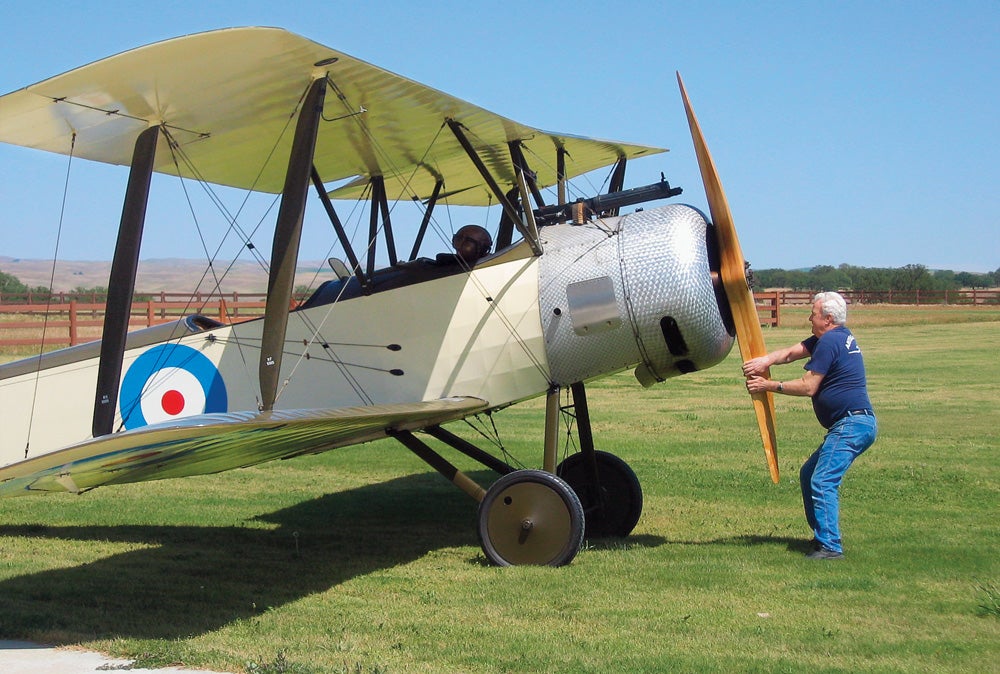


A few years ago my friend Javier Arango and I got to talking about certain oft-repeated statements about the airplanes of World War I. Javier has a collection of very accurate reproductions of World War I airplanes (as well as a genuine Camel and Bleriot 11) and happens to be a scholarly fellow with a Harvard bachelor’s degree in the history of science. He is accordingly interested in teasing out the threads of truth from the tapestry of memory and invention that is the past. We thought it would be interesting to do some flight tests of his airplanes using modern measuring equipment, and to compare the results with contemporary accounts. It was — and continues to be — widely believed, for instance, that the Fokker triplane of Manfred von Richthofen was a superior climber, but theoretically it should not have been. Was it, in fact? Is it true that rotary-engine airplanes, because of the huge gyroscopes on their noses — the entire engine spun, and with it a huge propeller — turned more readily in one direction than the other? These were the kinds of questions that we hoped to resolve with numbers rather than anecdotes.
I learned when visiting the Naval Test Pilot School at Patuxent River, Maryland, a couple of years ago that relatively inexpensive flight-data retrieval systems are now available. They contain solid-state gyros and accelerometers and a GPS unit, and record a dozen or so parameters — angles, speeds, accelerations and so on — at intervals of a quarter of a second. Unlike the large built-in “black boxes” (actually orange) beloved of the NTSB, these are little, self-contained battery-powered cubes that you stick somewhere in the cabin with tape or Velcro. The stored data can be played back on a computer, either as graphs of selected parameters or as a flight simulator-style rerun of the flight, seen from outside the airplane or from inside the cockpit, with photographically accurate scenery and all the other miraculous stuff we have come to expect from Google Earth.