














Register

Technology and Judgment: Getting to Know You

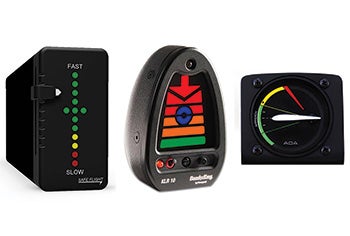
** Angle of attack gauges come in various shapes
and sizes, but the common denominators are green,
yellow and red indications depending on how close
the airplane's wings get to the stall.**
Gemini Sparkle

Key Takeaways:

  • A new FAA policy has made Angle of Attack (AOA) indicators easier and more affordable to install in general aviation aircraft, leading to a surge in their availability.
  • AOA indicators provide a more accurate and direct measure of a wing's proximity to a stall than airspeed, which can be misleading due to factors like G-loading or aircraft weight.
  • These systems offer crucial "trend information" on how rapidly an aircraft is approaching or moving away from a stall, significantly enhancing safety and supplementing traditional airspeed information for all pilots, especially during maneuvers.
See a mistake? Contact us.

You may have noticed, if you follow the press releases, a sudden multiplication of angle of attack indicators for smaller general aviation aircraft. This burst of activity is due to a new FAA policy allowing AOA instrumentation to be installed in certified airplanes without a burdensome STC process, as long as it is independent of the existing pitot-static plumbing. The systems on offer are relatively cheap — $1,500 or so, though some systems aimed at the homebuilt market cost as little as $350 — and include offerings from major names like Garmin and BendixKing, so they stand a pretty good chance of being widely adopted into GA aircraft.

Speed is a very accurate and sensitive indicator of AOA, provided that the airplane is not pulling any G’s. Jon Karkow, the lead aero engineer at Icon, has pointed out to me that the design of the round airspeed indicator, with zero at the top of the instrument rather than at the lower left as on most dial indicators, may have been intended to make the needle act like an angle of attack indicator in the low-speed regime. (By the same token, Karkow adds, a test pilot’s trick for helping to maintain a steady altitude is to fly at one of the thousands plus 750 feet — 7,750, 8,750, etc. — so that the altimeter needle points to the left and behaves, again, like an angle of attack indicator, moving up when the nose is high and down when it’s low.)


Peter Garrison

Peter Garrison taught himself to use a slide rule and tin snips, built an airplane in his backyard, and flew it to Japan. He began contributing to FLYING in 1968, and he continues to share his columns, ""Technicalities"" and ""Aftermath,"" with FLYING readers.

Ready to Sell Your Aircraft?

List your airplane on AircraftForSale.com and reach qualified buyers.

List Your Aircraft
AircraftForSale Logo | FLYING Logo
Pilot in aircraft
Sign-up for newsletters & special offers!

Get the latest stories & special offers delivered directly to your inbox.

SUBSCRIBE
