











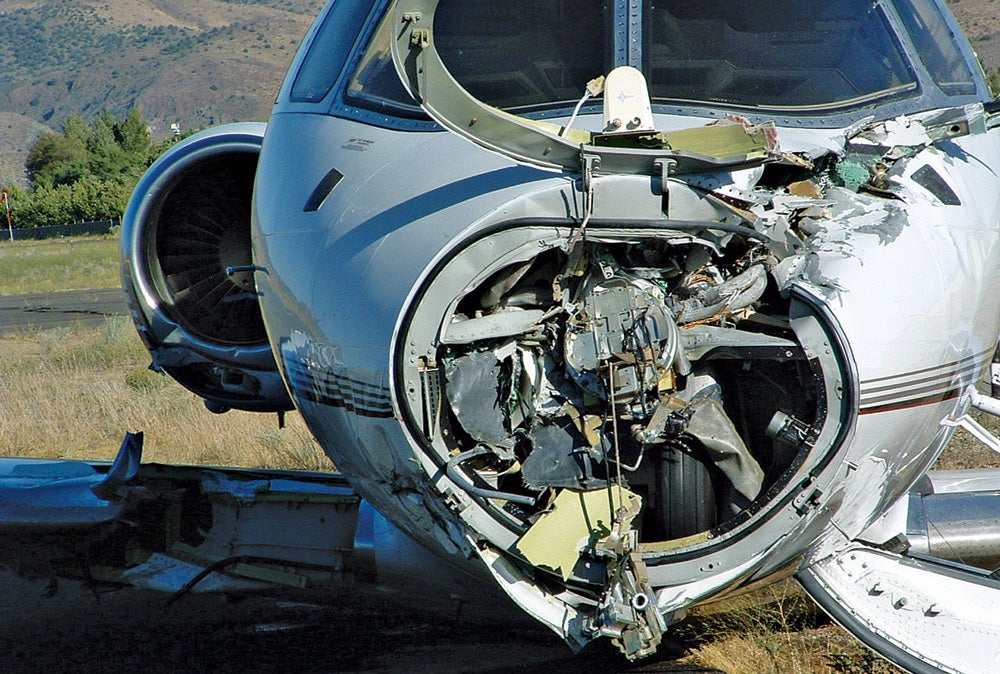


Bird strikes seem to be in the news a lot recently, especially since geese brought down a US Airways Airbus 320, leading to the “miracle on the Hudson” and the article I wrote in the May 2009 issue of Flying about Things That Go Bump (Often at Night). There are other objects in the sky that present a collision hazard to powered airplanes, usually during daylight hours. Some present very little risk. For example, even though hundreds of weather balloons are launched each day in North America, there is no record of a collision between an airplane and a balloon or its instrument package. The balloons climb at around 1,000 feet per minute, and the instrument package, which generally does not weigh much more than a pound, descends rapidly under a small parachute. The weather observer is required to postpone the launch if there is an aircraft in the area, and to coordinate the release with ATC if it is within five miles of a controlled airport.
Skydivers are another matter. While collisions between airplanes and skydivers are rare, when an airplane strikes something weighing around 200 pounds, the results are often fatal for the skydiver, the airplane’s occupants or both. In November 1993, a Piper PA-28-161 collided with a free-falling skydiver while in cruise flight over the Northampton, Massachusetts, airport. The NTSB report states that the pilot of the jump aircraft contacted Bradley Approach Control immediately after departing Northampton Airport and informed the controller he was climbing to 8,000 feet with jumpers. The controller had already assigned a discrete transponder code earlier in the day and requested the pilot to inform him one minute prior to releasing the jumpers, which he did.

