











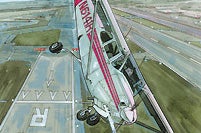


I was at the tail end of three months of training for my CFI reinstatement check ride. My instructor Kevin and I were flying into a deepening Pacific Northwest twilight as we descended westbound over Lake Washington toward Boeing Field/King County International Airport (BFI). We began maneuvering to enter right traffic for Runway 31R in four-one Romeo, one of our flying club’s Cessna 172RGs. The wind was almost directly straight down the runway at five knots, and the air was perfectly smooth.
I had slowed and performed a GUMP check before we crossed the shoreline descending to the traffic pattern altitude of 1,000 msl on a 45-degree entry onto downwind. Boeing Field’s twinkling runway lights in the valley ahead slowly slid into view at our two o’clock as we began clearing the high Mount Baker bluff. From my position in the right seat, I could see a heavy air cargo Boeing 767 rotating about halfway down Boeing’s 10,000-foot-long Runway 31L and pitching into a steep initial climb. I recall briefly thinking, “hmm … .” The rotation point was adjacent to the approach end of the general aviation 3,710-foot-long Runway 31R on which we were cleared to land. That, plus the fact that the runways were very close together, made little alarm bells go off in my head. However, I quickly became absorbed in setting up our downwind leg, following landing traffic ahead and setting up for the 180-degree power-off accuracy landing Kevin suggested. No worries, though. Air Traffic Control would keep us out of trouble. With the mix of Boeing Company experimental and production flight tests, heavy jet commercial cargo, corporate jet transport movements and lots of general aviation flight training to deal with, Boeing Field controllers are justifiably fastidious about wake turbulence. Like all light-airplane pilots at BFI, Kevin and I had spent a lot of time waiting out wake separation delays and performing go-arounds at pattern altitude.

