














Register

The Ups and Downs of Turbulence

Gemini Sparkle

Key Takeaways:

  • The commonly understood maneuvering speed (Va), while often defined as "turbulence penetration speed," is primarily derived from the aircraft's positive G-load limit, meaning it protects against damage only from upward forces.
  • A critical flaw in relying solely on the published Va is that real turbulence involves both positive and negative G-loads. There exists a significantly slower "negative Va" which is not published but necessary for protection against downward forces.
  • Since the published Va does not account for negative G-loads, pilots are not fully protected from structural damage if they only slow to the published Va in severe turbulence.
  • To ensure true protection in serious turbulence, pilots should decelerate to a speed *slower* than the published Va, flying as slowly as possible while maintaining control, and exit the turbulent area promptly.
See a mistake? Contact us.

There are a lot of definitions out there for maneuvering speed (Va), including the textbook one that students deliver by rote, when asked. Unfortunately, most of the popular definitions don’t relate to the true meaning of this “life saving” speed. The best definition, albeit the shortest, is — “turbulence penetration speed” — the speed you should slow to as soon as possible when significant turbulence is encountered. But how much slower is that, really?

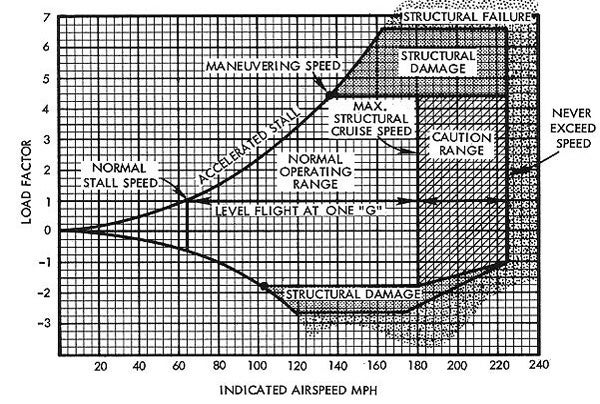
To understand the whole story, you need to look at a Vg Diagram — that’s the one you most likely last saw in your private pilot study materials. It’s a graph that illustrates the stall lines, the limit loads, ultimate limit loads and Vne as the “envelope” of the aircraft — and most of us have never seen an actual one for our aircraft! Va falls at the point where the ‘positive limit load’ line intersects the ‘stall’ line on the positive ‘g’ portion (upper) of the diagram. And we are told that if we are flying at that speed, the airplane stalls before it exceeds the limit, and thus can sustain no damage.


But, there is a problem with that. Look at the bottom portion — the negative ‘g’ part — of the Vg diagram. There is a similar point there where the ‘negative limit load’ (which is far less than the positive) intersects the stall line — effectively a “negative Va.” In virtually ALL cases, this is a significantly slower speed than Va on the positive ‘g’ side.

So, here’s the question. Have you ever experienced only positive, or “upward” turbulence (i.e. nothing to the negative or downward side)? I know that I surely haven’t. In serious turbulence, the bumps go both ways. What does this mean? Since no negative Va speeds are published — anywhere — you MUST decelerate to a speed SLOWER than Va to be truly protected! How much slower? Since nothing is specified here, just fly as slowly as you can and still have decent aircraft control — then fly out of the turbulence as soon as practical.

_

Alan C. Davis, Master CFI – Emeritus/CFI AIMEI Gold Seal / FAASTeam Representative. Davis is a also board member of SAFE (Society of Aviation and Flight Educators)._

FLYING Staff

FLYING Magazine is a one-stop resource for everything aviation, including news, training, aircraft, gear, careers, photos, videos, and more.

Ready to Sell Your Aircraft?

List your airplane on AircraftForSale.com and reach qualified buyers.

List Your Aircraft
AircraftForSale Logo | FLYING Logo
Pilot in aircraft
Sign-up for newsletters & special offers!

Get the latest stories & special offers delivered directly to your inbox.

SUBSCRIBE
