











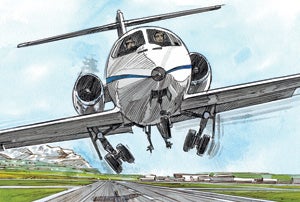


It was a wintry day in Salt Lake City with the temperature hovering around freezing and a high, overcast sky with good visibility. We were on the second leg of a three-leg day flying a Lear 35 from a military base to Washington, D.C., carrying three passengers including a VIP. I was sitting right seat as an instructor for my copilot, who was in line for an upgrade to captain and getting some left seat familiarity. He was a capable pilot who knew what he was doing, had flown left seat competently and was ready to head off to formal upgrade training.
Cleared for takeoff, we started to roll. My “student” was flying this leg and was doing a great job. As I called out “rotate,” he gently pulled back on the yoke and broke ground, and then he called “gear up.” As I raised the gear, there was a muffled explosion from the right rear, and the Lear began to yaw and roll to the right. Instinctively, I jumped on the controls only to find he already had what seemed like full left aileron and full left rudder applied and the airplane was responding, so I relinquished control and stated, “Your aircraft.” The nearly full control input was momentary, but in the “time compression” mode, which usually accompanies times like this, it seemed like an eternity. The airplane righted itself a few feet above the runway and began a slow climb as he relaxed some control input. The high altitude was taking its toll on our climb performance since we were near max gross weight, but thankfully the temperature was on our side. The airplane shook pretty violently and there was a loud buzzing sound coming from the rear of the aircraft, but as speed increased so did control response.

