











There are two successful business strategies an aircraft manufacturer might follow when creating a new product. One assumes the new airplane is so innovative that it will create its own market. In the other, an OEM watches a specific market develop until the day it’s ready to launch a competing aircraft, a machine incorporating lessons learned from years of observing competitors in the marketplace. The latter is the strategy Textron Aviation took when preparing the new Denali single-engine high-performance turboprop. Some might call the single-engine turboprop market a bit crowded if they look only at the last decade’s worth of delivery numbers from the General Aviation Manufacturers Association. The more appropriate word is consistent, with more than 200 airframes delivered almost every year. OEMs love consistency. The largest single-engine turboprop seller is Cessna’s Caravan series, with 1,062 delivered from 2008 through the second quarter of 2018, followed closely by the Pilatus PC-12, at 901 delivered; Daher’s TBM series, with 535; Piper’s M500/600, at 371; Quest’s Kodiak, at 245; and Mahindra’s Airvan 10, with 52. Prices range from $1.7 million for the Mahindra turboprop to $5 million for a typically equipped PC-12. In between, it’s $2.53 million for a Grand Caravan, $2.98 million for a Piper M600 and $4.22 million for a fully equipped TBM 930. While the Epic 1000 is not yet certified, the company is taking orders for $3.25 million. Cessna is currently taking Denali orders at $4.8 million apiece. Of course, comparing single-engine turboprops on a head-to-head basis isn’t exactly fair to any OEM, except for the fact that these other airplanes are flying, while the Denali for now is just a sweet mock-up and a collection of parts back home at the factory in Wichita, Kansas. Textron first showed a rough Denali mock-up at AirVenture 2016. For Rob Scholl, Textron Aviation senior vice president of sales and marketing for all commercial products, confidence doesn’t seem to be an issue. He notes that Textron Aviation’s two main divisions, Cessna and Beechcraft, have a long history of delivering impressive aircraft. When it comes to the Denali, “There’s lots of single-engine pilot interest too, including a very strong worldwide special-mission interest. Internationally, the turboprop market has been really strong lately, especially for some of the commercial operators in Europe.”
First Look: Cessna Denali

Key Takeaways:
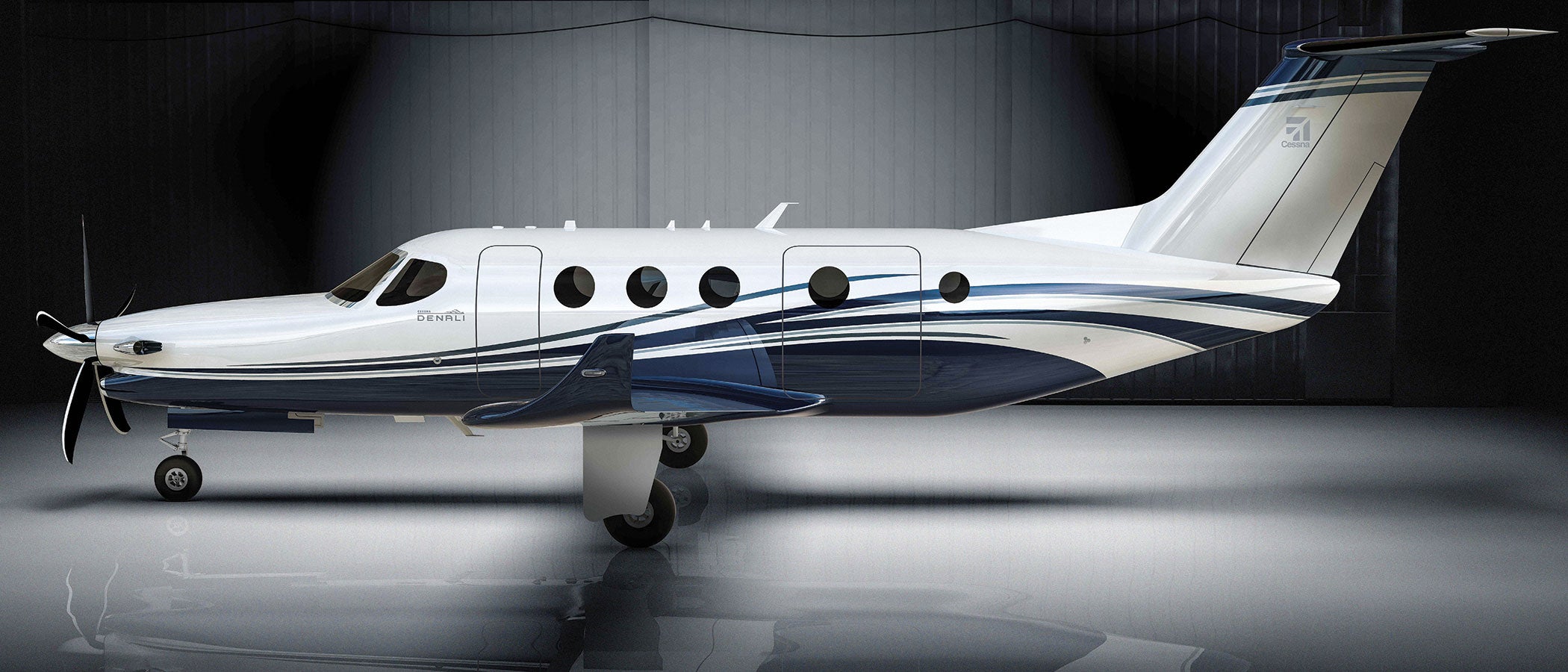
- Textron Aviation's new Denali single-engine turboprop is strategically entering a consistent market, aiming to rival competitors like the Pilatus PC-12 by offering a larger cabin, comparable speed, and advanced features at a competitive price.
- A key differentiator for the Denali is its all-new GE Catalyst engine, which incorporates a clean-sheet design, additive manufacturing, higher compression for 15% better fuel efficiency, and a simplified single-lever FADEC control.
- The aircraft features a versatile and spacious cabin designed to be 5% larger than the PC-12's, a modern Garmin G3000 avionics suite with voice command, and utilizes advanced monolithic machining for efficient construction.
- The Denali, priced at $4.8 million, was expected to have its first flight early in the year following the article's publication (2018), with FAA certification and entry into service targeted for the first half of 2020.
Key takeaways sponsored by Aviator Pro | Start Your Training ->
See a mistake? Contact us.

