‘Aviation Start’ Episode 8 Maps the Path From Enlisted Mechanic to Vice President of Maintenance
Recorded live at NBAA-BACE, ACI Jet's Adam Barron explains how he earned his A&P in the Air Force, why the maintenance shortage is already here, and the one thing he can't teach a new hire.
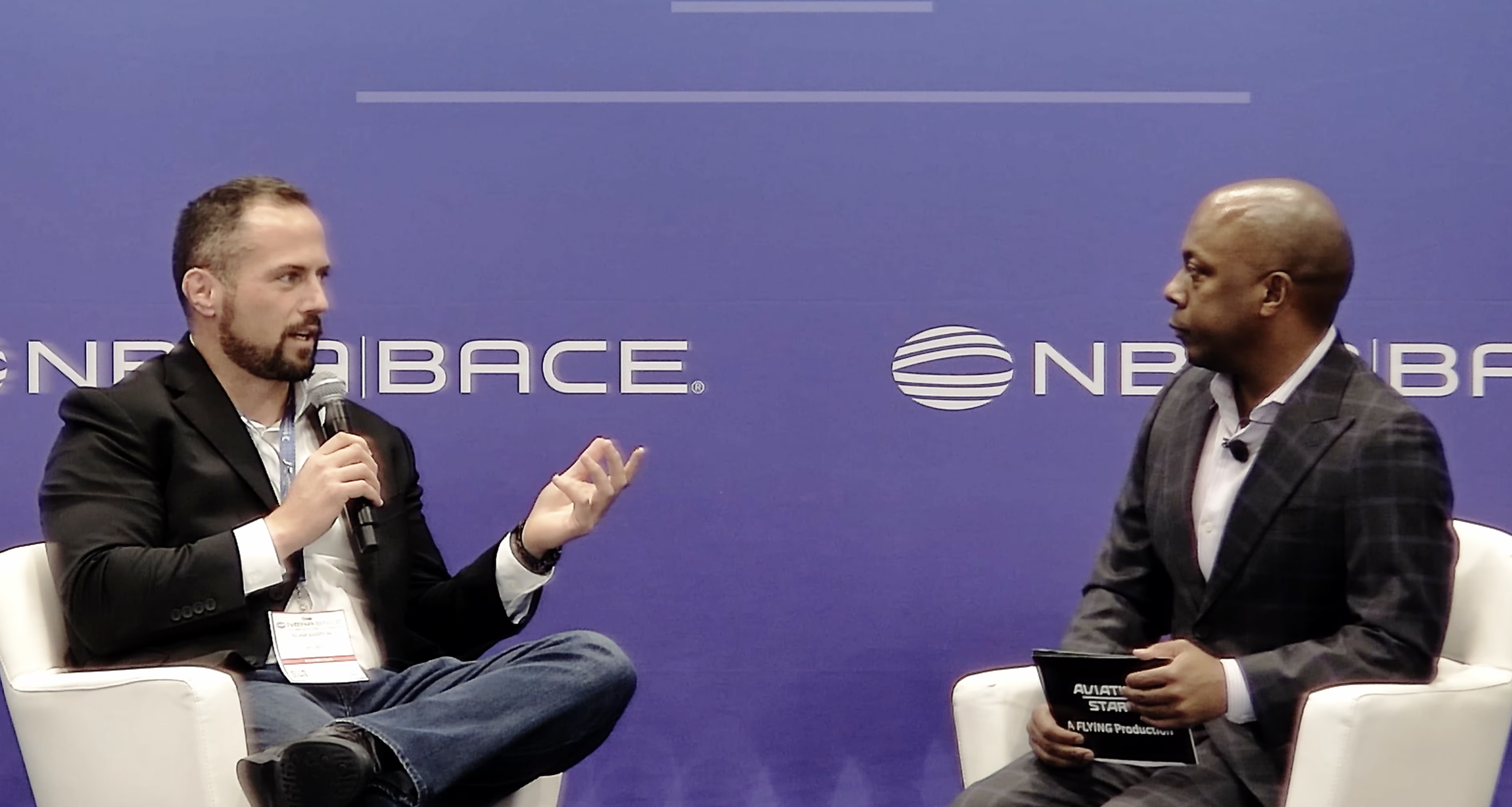
Jamail Larkins speaks with Adam Barron [Credit: FLYING]
Key Takeaways:
Business aviation is facing a critical workforce shortage, requiring more than 69,000 new mechanics as roughly 83 percent of current technicians are expected to retire within the next decade.
To overcome the industry's licensing and experience barriers, aspiring technicians can pursue pathways through military service or Part 147 programs, such as the local community college partnership established by ACI Jet.
While technical aircraft knowledge can be taught on the job, employers heavily prioritize soft skills, emphasizing that passion, curiosity, a strong attitude, and a commitment to lifelong learning are essential for career growth.
The eighth episode of Aviation Start, FLYING’s career-focused video podcast hosted by Jamail Larkins, was recorded live at the 2026 NBAA Business Aviation Convention and Exhibition in Las Vegas, and it takes on the job Larkins calls the most in-demand in the aviation ecosystem: aircraft maintenance.
Business aviation alone needs about 33,000 new pilots, Larkins noted, but it needs more than 69,000 mechanics, and roughly 83 percent of the people who maintain airplanes today are expected to retire over the next 10 years.
His guest is Adam Barron, vice president of aircraft maintenance at ACI Jet in San Luis Obispo, California, and a member of NBAA’s 2026 Business Aviation Top 40 Under 40. Barron’s career started on the flight line as an enlisted airman in the U.S. Air Force, where his first assignment was RAF Lakenheath in England working on F-15s, followed by several deployments. He finished his service in Florida, and that is where he found his way into civilian aviation.
Building His Own Pathway
In his last year in the Air Force, Barron enrolled at the Embry-Riddle Aeronautical University Worldwide campus on base. The university’s catalog listed airframe and powerplant courses, but the campus didn’t offer them because not enough students signed up. That made no sense to Barron on a base full of aircraft maintainers who would likely want to keep working on airplanes after they separated.
“I basically told the dean of that chapter of Embry-Riddle that if you hire the instructor, I’ll get you the students,” he said.
He went squadron to squadron at Duke Field, Hurlburt Field, and Eglin Air Force Base and signed up 10 students, enough to justify the hire. The result was a one-year undergraduate certificate course toward the A&P, and when he finished, the university paid for his oral and practical exam.
Barron said the military route builds character and worked well for him, but it is not the only way in. Part 147 schools offer another path for anyone the military doesn’t suit, and the right answer depends on the person’s goals.
The Catch-22, and What ACI Jet Did About It
Larkins asked about a common complaint on TikTok and Reddit: that there are no opportunities in aviation maintenance. Barron said the frustration is real, but the cause is structural. FAA requirements for the A&P certificate call for a set amount of experience.
“To get the job, you have to have the experience, and you have to have the experience to get the license to get the job,” he said. “So it’s kind of back and forth.”
The military fills some of that gap and Part 147 schools fill other pieces of it, but Barron doesn’t claim to have the whole industry’s answer. What ACI Jet does have is its own. The company partnered with Cuesta College, the local community college, to start a Part 147 school so people who want to stay in San Luis Obispo have a way into a good job with a good company.
“We see the shortage,” Barron said. “The shortage isn’t coming. It’s here.”
For anyone who walks up to the hangar and says they want an A&P, Barron said he points them to that school, then explains the landscape honestly, including the experience-versus-license mountain they will have to climb one way or another.
“The barriers to entry are there for a reason,” he said. “Anyone who wants to overcome them can overcome them, and here’s the tools on how you can do that.”
What He Can Teach, and What He Can’t
Asked what carried him from an enlisted mechanic overseas to the executive ranks, Barron didn’t point to a credential.
“I think staying passionate and curious,” he said. “That’s the key to a lot of things in life, whether you’re working in aviation or outside of it.” He enjoys the challenges, the problem solving, and the people, but he added a warning: “The higher you climb, the more challenges you’re going to see. So don’t think that’s not coming.”
For a new technician heading into an interview, his advice is to say so plainly: tell the person across the table that you are a lifelong learner.
“If I hire a new mechanic straight out of school, I can’t teach him how to come in and be passionate, but I can teach you the airplane,” he said. “I can teach technical knowledge. I can’t teach your attitude. So I would say attitude is everything. It’s one of the only things under your control all the time.”
As for what a vice president of maintenance actually does, Barron said no two days match. Hiring, training, onboarding and offboarding aircraft, conformity inspections, and preventing AOGs all cross his desk, and ACI Jet has trained its maintenance team to follow the operational side of the business closely.
“The name of the game being an A&P is safety and reliability,” he said. “Your job is basically to be a good steward of the aircraft owner’s decisions in the aviation space. If you had to sum it up, that’s basically what your job is.”
His last word was for people who want in but are afraid to commit. Barron, who is reading Peter Drucker’s “The Effective Executive,” said the book describes how people hesitate to take the leap into the next chapter of their lives because they fear they can’t get back out. His counter is to lower the stakes: look at apprentice programs, take a hangar tour, and ask what a typical day looks like. Most people in aviation are passionate and curious about what they do, he said, so anyone who joins will be surrounded by like-minded people. And if it turns out not to be for you, that is fine too.
Episode 8 of Aviation Start is available now on FLYING’s YouTube channel and all major podcast platforms. Aspiring aviation professionals can get matched with eligible scholarships from a database of more than $20 million at aviationstart.org.