
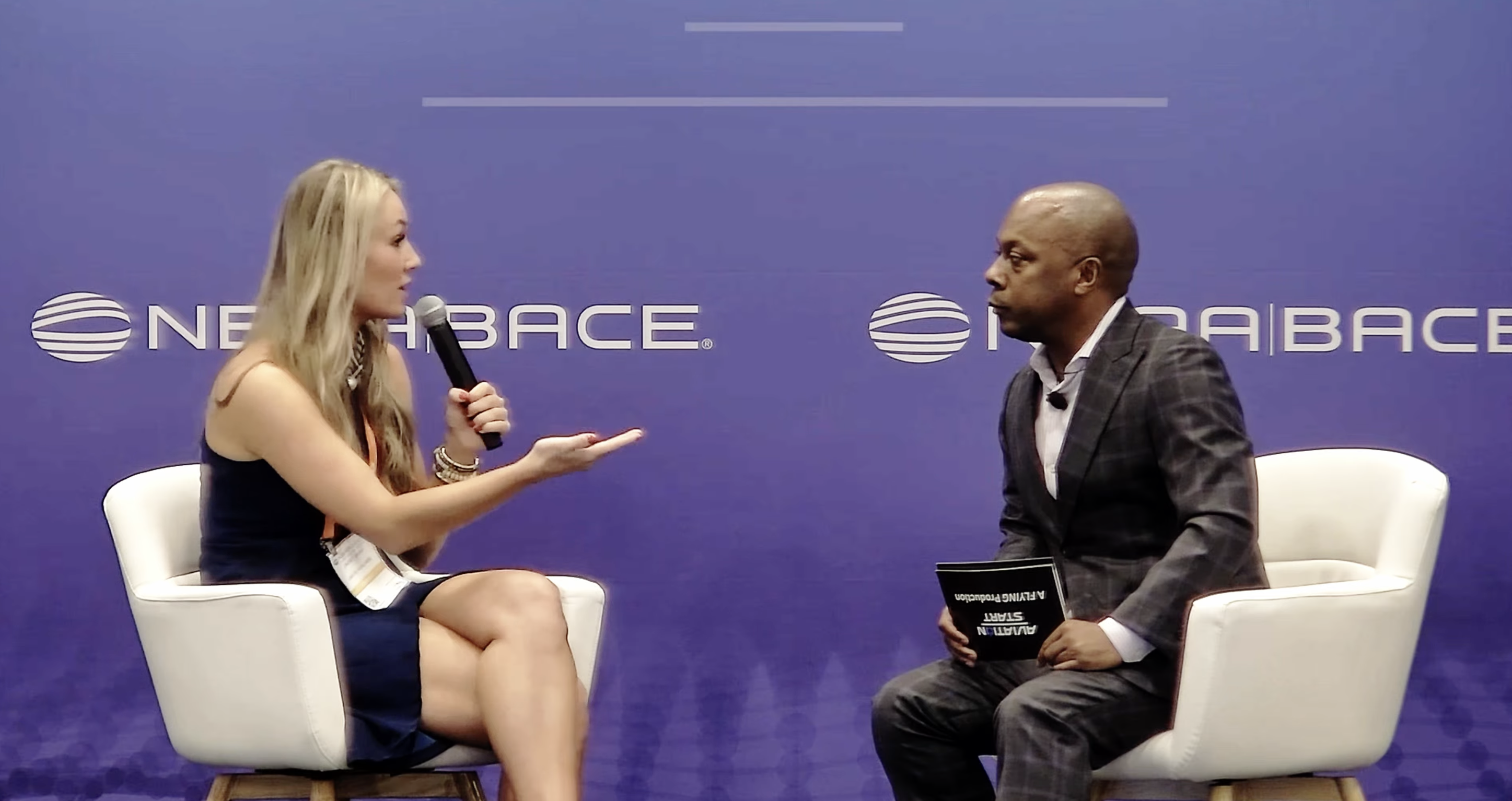


The seventh episode of Aviation Start, FLYING’s career-focused video podcast hosted by Jamail Larkins, heads to the cabin.
In partnership with NBAA, FLYING Magazine was able to record this episode on location at the NBAA Business Aviation Convention & Exhibition (NBAA-BACE) in Las Vegas. It is the first of three conversations with members of NBAA’s 2026 Business Aviation Top 40 Under 40 class.
Guest Lindsey Savko is a contract corporate flight attendant, registered nurse, student pilot, and the owner of LinRose Worldwide, which provides nursing services aboard private jets. She is also an ambassador for Corporate Angel Network, a role she shares with Larkins.
Savko grew up around hangars from the age of 5. Her father is a retired Gulfstream G650 pilot, her mother is a dispatcher, and her brother flies for Republic Airways.
“We all had that aviation bug at a really young age,” Savko said.
She still didn’t expect to land in the industry so early. She went through an accelerated nursing program and works as a surgical orthopedic nurse, and she started flying as a corporate flight attendant at 20.
Larkins noted that the combination has history behind it. Ellen Church became the first flight attendant in 1930 after convincing Boeing Air Transport that having a nurse on board would make passengers more comfortable. Church had wanted to be a pilot, an opportunity that wasn’t open to women at the time.
Savko said she has never had to use her medical training in flight, but her clients know it is there.
“When people hire me as a corporate flight attendant, they know that they’re getting a qualified registered nurse, and that provides that comfort,” she said.
Six Days in Savannah
For anyone wondering where to start, Savko described her initial training at FlightSafety International in Savannah, Georgia. The six-day course covers water training, ditching, and evacuating the aircraft on land or water. She has since worked aboard types including the Dassault Falcon 7X and the Gulfstream G450 and G550.
“Every plane is different,” she said. “You really need to know, in case there is an emergency, how to evacuate properly.”
What the course did not cover in depth was food service, and Savko said many operators hire flight attendants with culinary backgrounds. She is looking at catering training through DaVinci Inflight Training Institute to round out her skills.
“I’m a nurse. I come with safety. That’s what I bring to the table,” she said.
Initial training is paid out of pocket with no guarantee of a job afterward, which is where scholarships come in. Savko pointed to Women in Corporate Aviation as one source. Last year she received a $2,500 Corporate Aviation Association Scholarship for Future Leaders through NBAA, which went toward her flight training.
Larkins added that aviationstart.org lists a couple hundred scholarships that can be applied toward becoming a corporate flight attendant.
“A lot of people think that scholarships are only available if you want to become a pilot, maybe if you want to get inside of the maintenance side of the aviation industry, but it’s simply not the case,” Larkins said.
Building a Contract Business
Savko works as an independent contractor rather than on salary with a single flight department, a choice that trades security for flexibility. Larkins asked whether making that jump was scary.
“You really need to take a risk in this industry,” she said, adding that it took about five years to build her clientele.
Her advice for getting hired is to attend education sessions, regional forums, and every networking event possible, and to be direct once you are there. She suggested printing a business card and telling people, “I did my education. I want to learn. I want to grow.”
The same curiosity led her toward the cockpit. In 2021, a few trips into her career, she asked a woman boarding the airplane whether she was a flight attendant too.
“She goes, ‘No, I’m a pilot, actually,'” Savko said. “She was only 26 and I was 21, and now here I am, 27, building my pilot’s license.”
Savko now learns from the pilots she flies with, often from the jump seat, and is finishing an advanced practice nursing program in April.
Sorrow Into Purpose
Savko found Corporate Angel Network at NBAA-BACE in 2023, a year after losing both of her grandparents to cancer within six months. The organization has arranged nearly 70,000 flights since 1981, placing cancer patients in empty seats on business aircraft headed toward their treatment.
“I turned that sorrow into purpose,” she said.
As an ambassador she connects corporate aviation executives with the organization and speaks with patients by phone from its headquarters. In September she represented the group at Girls in Aviation Day in White Plains, New York, talking with girls 10 and older about careers many of them had never heard of.
“There is a gray area there,” Savko said. “We don’t really know how to get involved or where to start.”
Larkins closed with the scale of the opportunity. The aviation industry is hiring about 400 people a day, he said, and with a retirement wave hitting every segment, that pace is expected to hold for the next decade.
Episode 7 of Aviation Start is available now on FLYING’s YouTube channel and all major podcast platforms. Aspiring aviation professionals can get matched with eligible scholarships from a database of more than $20 million at aviationstart.org.