













Register

Technicalities: Faster than a Boat

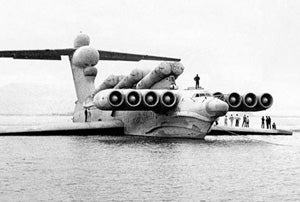
** The Lun's engines tilted to direct the exhaust
under the wing for takeoff.**
Gemini Sparkle

Key Takeaways:

  • Ground effect, recognized since the early 20th century, is an aerodynamic phenomenon that reduces an aircraft's induced drag when flying close to the surface, impacting takeoff, landing, and overall efficiency.
  • The potential for efficient, high-speed travel within ground effect inspired a 1934 proposal for "aerial steamers" and led to extensive development of "ekranoplanes" by the Soviet Union.
  • Soviet ekranoplanes, such as the massive "Caspian Sea Monster," were large ground effect vehicles designed for military and transport, featuring unique configurations to manage stability and operate effectively over water.
  • Despite their impressive capabilities and potential as economic transporters, ground effect vehicles (WIGs) have largely failed to find widespread commercial application, remaining a technology still seeking a viable market.
See a mistake? Contact us.

(September 2011) In 1920 it was already common knowledge among pilots that, as airplanes got very close to the ground, they seemed to slide along on a slippery cushion of air. A decade later, the phenomenon — “ground effect” — had been investigated in wind tunnels and flight tests and was well documented, even if the precise mechanisms involved were still imperfectly understood. A 1934 summary of existing research by a French investigator, Maurice Le Sueur, was translated by the National Advisory Committee for Aeronautics, NASA’s wonderfully productive and helpful predecessor, and published as Technical Memorandum 771 under the title “Ground Effect on the Takeoff and Landing of Airplanes.”

“Observations on airplanes in free flight,” Le Sueur wrote, “have enabled us to observe certain systematic phenomena such as: the greater facility of low-wing airplanes for taking off; the impossibility of certain heavily loaded airplanes to gain altitude; the prolonged gliding power of low-wing airplanes at landing, etc.”

Peter Garrison

Peter Garrison taught himself to use a slide rule and tin snips, built an airplane in his backyard, and flew it to Japan. He began contributing to FLYING in 1968, and he continues to share his columns, ""Technicalities"" and ""Aftermath,"" with FLYING readers.

Ready to Sell Your Aircraft?

List your airplane on AircraftForSale.com and reach qualified buyers.

List Your Aircraft
AircraftForSale Logo | FLYING Logo
Pilot in aircraft
Sign-up for newsletters & special offers!

Get the latest stories & special offers delivered directly to your inbox.

SUBSCRIBE
