
“Is there a way to compute the strength of up- and downdrafts based on the amount of increase or decrease in airspeed? If I’m cruising along at an indicated 135 knots with a constant power setting, maintaining altitude and see my airspeed decrease to 110 knots as I pitch up to overcome downdrafts while maintaining altitude and power, it seems there should be some way to calculate the strength of those downdrafts based on the loss of airspeed. Coming out of the downdraft and into an updraft would have the reverse effect, with maybe 155 knots or so the resulting airspeed as the airplane pitches down to maintain altitude. I thought this might be a simple right-triangle problem, but the more I think about it, the more it seems like it’s probably more complicated than that.”
Technicalities: How to Calculate the ‘Strength’ of an Updraft

Key Takeaways:
- The strength of up- and downdrafts can be calculated based on changes in an airplane's airspeed while maintaining constant altitude and power.
- Encountering an updraft while holding altitude and power is equivalent to gaining "gift" horsepower, leading to increased airspeed; a downdraft has the reverse effect.
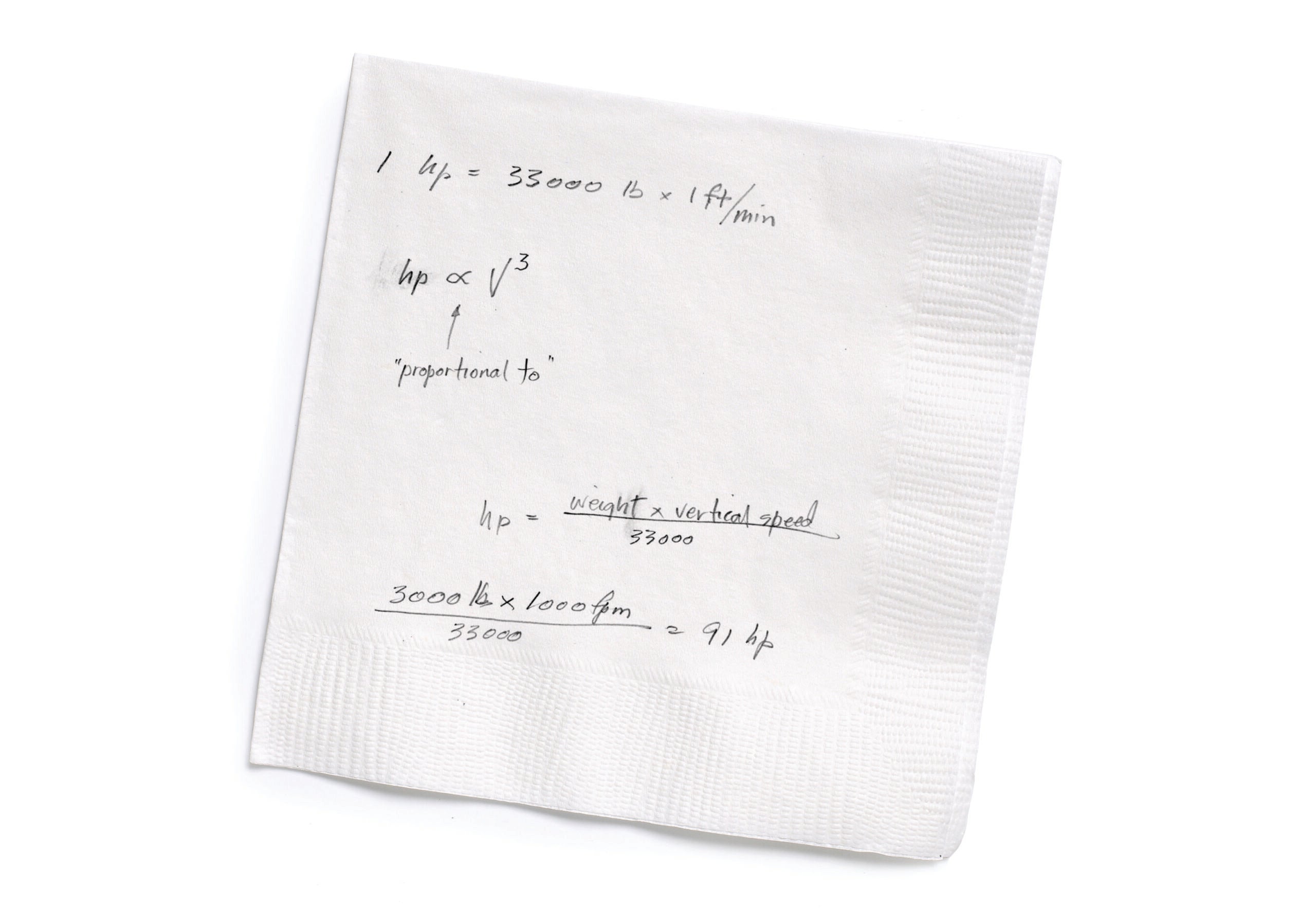
- The calculation involves relating the change in airspeed to an equivalent change in power (using an approximate "cube rule" where speed is proportional to the cube root of power) and then converting this power difference into a vertical air velocity.
- The underlying principle is that vertical speed and horsepower are interchangeable, allowing pilots to estimate draft strength from observed airspeed variations.
Key takeaways sponsored by Aviator Pro | Start Your Training ->
See a mistake? Contact us.