














Register

Technicalities: Monsters (Kalinin-7)

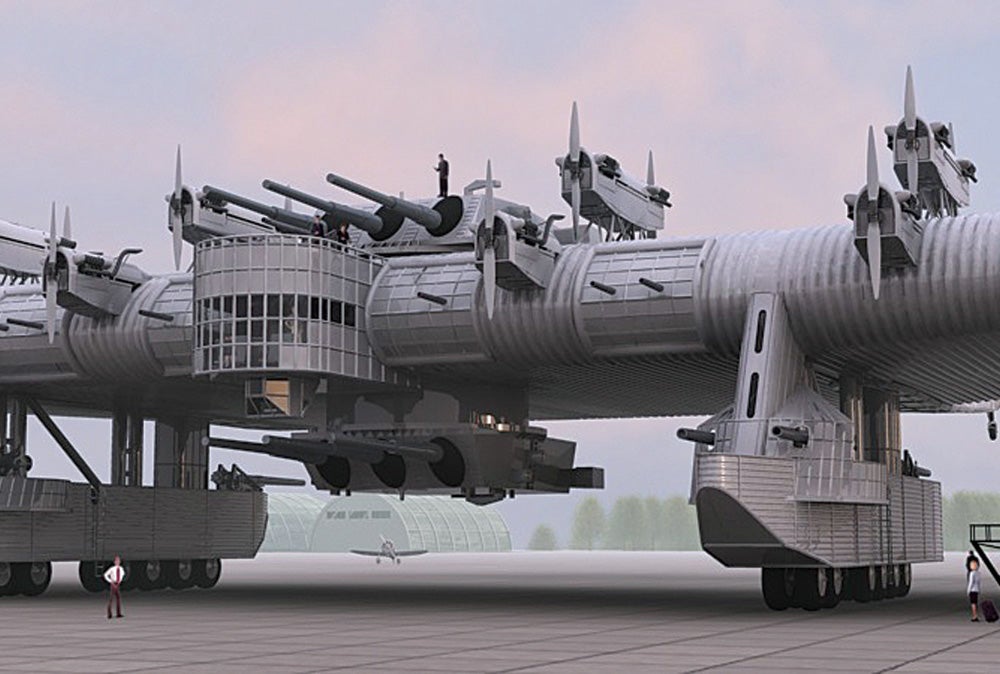
This Internet monster claims to be a Kalinin K-7,
but the fraud is obvious: The people are modern,
and pictures from the Soviet Union were never in focus.
Gemini Sparkle

Key Takeaways:

  • The article debunks internet hoaxes about impossibly gigantic aircraft like the "Megalopseudokalinin" while acknowledging the existence of real, very large historical planes such as the Russian Kalinin K-7.
  • It explores early 20th-century conceptual giants like Norman Bel Geddes' luxurious "Airliner No. 4," highlighting how their grand visions failed to anticipate the operational economics that prioritize passenger density and efficiency over opulent amenities.
  • Although theoretical physics suggests no fundamental structural limit to an airplane's size, practical factors like airport infrastructure and modern economic realities impose constraints on the growth of real-world aircraft, exemplified by the current largest, the Antonov An-225.
See a mistake? Contact us.

May 2010 ONE OF THE MORE persistent hoaxes drifting about on the Internet concerns an airplane called the Kalinin K-7. Built in the early 1930s, the K-7 was Russian, and big. Really big. Russian designers those days displayed a positive passion for sheer size; Igor Sikorsky’s Ilya Muromets, for example, which flew just 10 years after the Wrights’ first powered hop, had four engines and a wingspan of more than 100 feet. The British firm of Handley Page built something similar. But the K-7 dwarfed them all. Its wing was an immense ellipse with a span of 174 feet — just 20 feet shy of a 747’s — eight feet thick and 35 feet from leading to trailing edge at the center. In a civil version, 120 passengers were to be seated spanwise within the wing. Twin booms supported the smallish empennage, and six engines of 750 horsepower each stood side by side on its leading edge. One or two pusher engines — reports differ — were added when the gigantic monoplane, which was of steel construction, was found to be heavier than anticipated. Its reported all-up weight was 84,000 pounds.

The K-7’s landing gear was unusual, being carried in two pods resembling amphibious floats but about the size of motor homes. In the military version, these were equipped with machine gun turrets. They were connected to the main structure by a thicket of struts and by a couple of very large tubes that, I suppose, housed stairways for the gunners.


Peter Garrison

Peter Garrison taught himself to use a slide rule and tin snips, built an airplane in his backyard, and flew it to Japan. He began contributing to FLYING in 1968, and he continues to share his columns, ""Technicalities"" and ""Aftermath,"" with FLYING readers.

Ready to Sell Your Aircraft?

List your airplane on AircraftForSale.com and reach qualified buyers.

List Your Aircraft
AircraftForSale Logo | FLYING Logo
Pilot in aircraft
Sign-up for newsletters & special offers!

Get the latest stories & special offers delivered directly to your inbox.

SUBSCRIBE
