











FAA Releases Advisory Circular Covering ADS-B Ops
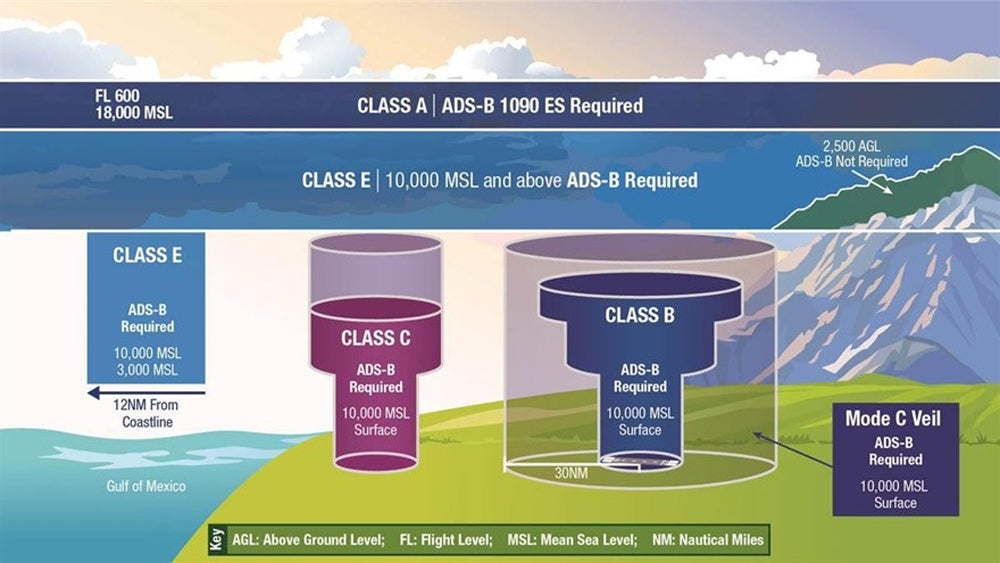
The diagram included in the advisory circular gives an overview of the equipment requirements for ADS-B. FAA
Gemini Sparkle

Key Takeaways:

  • The FAA issued Advisory Circular (AC) 90-114B to guide Part 91 pilots on Automatic Dependent Surveillance-Broadcast (ADS-B) operations and compliance, clarifying existing regulations.
  • The AC details the specific ADS-B equipment types required for different airspaces, such as 1090ES for Class A and either 1090ES or UAT for operations outside Class A.
  • A crucial point from the AC is that ADS-B is not a substitute for a pilot's visual scan for traffic and can even be a distraction, emphasizing the continued importance of looking out the window.
See a mistake? Contact us.

As we turned over the calendar on 2020, the era of required ADS-B equipage in the United States began—with certain exceptions. To this end, the FAA released its advisory circular, AC 90-114B, “Automatic Dependent Surveillance-Broadcast Operations,” on December 30, to provide guidance for those pilots flying under Part 91.

Specifically, the AC expands upon the rules governing ADS-B Out operations, FARs 91.225 and 91.227, and its appendices give procedures for utilizing ADS-B In, as well as other functions, within the National Airspace System. As with any AC, the document itself does not constitute any particular law or regulation, but is issued to give clarity to the associated regs.

The AC explains the various forms of ADS-B equipment, and where each is required or can be used as a means of compliance. Flying has published its own reporting on the subject over the last several years as the compliance date of January 1, 2020, approached.

Especially pertinent within the new issuance of the AC (which superseded AC 90-114A, from March 2016) for pilots to review and ensure they understand is the Limitations section. From a pilot’s perspective, most notable is the emphasis that ADS-B—though reportedly now registering more than 80-percent equipage on turbine aircraft, for example—is not a replacement for looking out of the window (OTW, in the verbiage of the AC). The mandate, while promoting higher visibility on traffic in your vicinity while flying, is not an excuse to quit your scan for traffic—and could be a distraction.

If you plan to operate within Class A, your aircraft will need to have the Extended Squitter ADS-B (commonly referred to as “1090ES”) installed and operational, and you’ll need to comply with 91.227. Outside of Class A you fall under 91.225 and must comply with 91.227, but can utilize either the 1090ES or the Universal Access Transmitter (UAT) ADS-B operating on 978 MHz. For the specific flight plan codes you’ll need to use on those flights for which you need to file, refer to the AC, and don’t hesitate to contact the agency for guidance if you have any questions.

The AC also covers special missions, such as formation flights, and exceptions to the rule for aircraft built without electrical systems. The means of compliance in both instances are similar to those for operations that would normally require a transponder—but you’ll still need a close read of the corresponding sections before you launch into the new year.

Ready to Sell Your Aircraft?

List your airplane on AircraftForSale.com and reach qualified buyers.

List Your Aircraft
AircraftForSale Logo | FLYING Logo
Pilot in aircraft
Sign-up for newsletters & special offers!

Get the latest stories & special offers delivered directly to your inbox.

SUBSCRIBE



