













On a beautiful day in San Diego, we loaded our two small airplanes for a trip to the Baja Peninsula. My friend Rick would fly his Cessna 177 with his friend Ted. Greg and I would fly the Finley Flyer, a vintage Piper 140 modified with a 180-hp Lycoming retrofit engine with only 500 hours on it. This little airplane had taken us faithfully to Baja many times, and we were confident she would do the same this weekend.
Greg loaded up three five-gallon cans of fuel, due to the scarcity of avgas in Baja. I noticed the cans were secured with a bungee cord. "Greg, if we crashed, we would be wearing those cans," I remarked. From flying with John and Martha King I had learned to secure anything that could fly around in the cockpit. In one of their safety seminars the Kings recalled crashing in a field and a flying toolbox taking off a swatch of Martha's scalp. I used the seat belt to grab the cans through their handles, tightening them down so hard one of the vents popped. I thought that ought to hold them. This simple precaution may have saved our lives.

We headed out as a flight of two from Gillespie Field, San Diego, on a south-southeast course to check in at San Felipe, Mexico. Rick called ahead to open our border-crossing flight plan. Checking in at San Felipe, we had our papers stamped numerous times and took off south down the magnificent coastline. We were excited as we crossed over into the frontier. The chatter on our inter-plane frequency filled with jokes as we flew over the spectacular scenery of the San Jose Mountains. Cruising down Baja's east coast, I asked Greg, "If we lost our engine, where would you put down the airplane?" I like to ask this question just to maintain safety awareness. I had no idea it would become a critical question I'd be asking myself very soon.
After several hours of flying and almost 360 miles south of the border, we approached one of the most beautiful bays anywhere: Bahia de Los Angeles. We were eager to get to our final destination, San Francisquitos, only 30 minutes south, and decided to cut across the bay to save time and fuel, putting us a few miles out over water.
Martha King has formulated an aviation version of Murphy's Law: If something can go wrong, it will go wrong, and at the worst possible time.
The sound was the most sickening sound you could imagine hearing in an airplane, a sound that jolted me into an adrenaline panic. A continuous muffled explosion accompanied a vibration so violent I thought our airplane might break up in flight. I looked out the window to see the fuel caps dangling at the ends of their tether chains and fuel vibrating out in a bandwidth pattern across the wings. If that was happening to the fuel, what the hell was happening to the engine? The smell of many years of cockpit dust and crankcase fumes streamed into our cabin. I got a good look at the engine and could see most of it. It looked fine-except we were flying and the prop wasn't moving.
An airplane makes a distinct sound as it cuts through the air without the masking noise of the engine running. For a millisecond, I was stunned to hear it. It makes more noise than you would think.
As the more experienced pilot, I said to Greg, "I've got the plane." On the radio I called out "Mayday! Mayday! Ricky, we are going in!" Then I thought, okay, now I'm a glider pilot. I instructed Greg to tighten his seat belt as tight as he could. He reminded me to open the door. Of course: Open the door. I aimed the airplane for shore and held it at best glide.
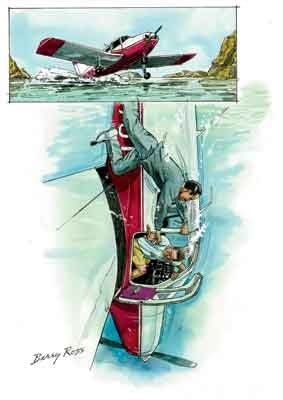
I knew as soon as the nosewheel hit we would flip over and slide underwater. I held the airplane off the water until we were just about to stall, then put it in a nose-high attitude to slap the tail into the water as hard as I could.
Greg later described being "hit in the face with a fire hose." To me it seemed like a six-foot wave broke a foot in front of me, sending a huge blast of water towards me. As the airplane flipped over onto its back, the cockpit instantly filled up with water. I couldn't tell up from down. But I did know we had come to a full stop: It was time to unfasten my seat belt and exit the airplane.
I saw light-that must be up. I pushed on the door: nothing. Immediately I pulled my legs up to kick it open. Stuck! I calmed down and thought, Okay, this is just a door, I can figure this out. Running my hand along the edge I found the side opposite the hinges, pushed hard, and it opened. Maybe I'd been pushing on the wrong part. My lungs ached now as I scrambled to get out. I shot up to the surface, moving fast, and popped through. Not as deep as I thought. The airplane was sinking nose first. I gasped two reflexive breaths, heart pounding in my ears. Holding the third breath, I dove back under to find Greg.
The airplane had settled like a fishing bobber, the engine acting as a lead weight, two-thirds of the fuselage submerged. Pulling the door open completely, I saw Greg had undone his seat belt and was waving his hand out the door. Reaching in, grabbing his shirtsleeve, I pulled him hard out of the cockpit and kicked in the direction of the surface. He was bleeding from a gash on his nose.
"Greg, get away from the plane, you're okay!" With its tail pointed straight up, the airplane slid quickly and silently beneath the water. Nothing remained except my floating gym bag and the nosewheel. Apparently the wheel had sheared off on impact. It was floating away with the current, north by northeast, into the Sea of Cortez.
I took a physical survey. It looked like Greg had a broken nose and some facial lacerations. He was not bleeding badly-a good thing, because sharks inhabit those waters. An orange object in the water caught my eye-a lifeboat! Someone threw us a lifeboat! I sprinted across the water to grab it. A life vest. I tried to put it on, but the webbing strap was drawn so tight I couldn't feed it through the plastic buckle. My hands were shaking so badly I couldn't draw any slack. I used my belt to secure the vest to me as best I could, then swam back to Greg. Fortunately, the waters of the Gulf have a very high salt content, which was helping us stay afloat. We started to swim towards shore, about a mile away.
We swam for what seemed like an hour. I asked Greg what time it was. He said 3 p.m. By 3:30 I noticed that not only were we not making sufficient progress, but triangulating our position, we seemed to be moving opposite from the way we had been swimming. The current that had carried off the nosewheel was sending us in the same direction.
I heard Rick's airplane buzzing like a mosquito, moving in and out of perceptible range. At one point he flew past us. I was sure he saw us-why did he fly away? After what seemed like a long time, he circled again. The airplane spotted us, came in low and started circling. Rick circled three times. Or maybe it was 50 times.
A small Mexican fishing boat-a panga-appeared on the horizon. I waved; the driver waved back. He pulled alongside and tried to pull us in with the help of Rick's passenger, Ted, who had a handheld radio guided by Rick from the air. We didn't have enough strength to get into the boat. They grabbed us like a couple of sea turtles and hauled us aboard. I was so happy to see them. They covered us with a sleeping bag and kept the speed down to keep us from getting any colder. We were shaking uncontrollably on the ride in. Greg was chafed raw from the swim, and we later discovered some interesting burns from what we suspected were plankton-size jellyfish, chemical burns from the gas, or maybe both.
Sleep didn't come easily that night. Every time I shut my eyes, all I could see was the moment of impact, the nose diving over and a rush of water coming at me. Rick's snoring didn't help either. The next morning we all assembled for a Mexican breakfast. The plan was for everyone to get in Rick's airplane and fly home. Adding up our total weight in my head, we were outside the envelope. I was not up for two crashes in one weekend. We decided Greg and I would take a bus home.

