











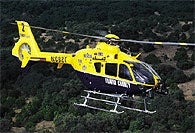


When a manufacturer can successfully meld form and function in a product’s design the results are invariably aesthetically and economically satisfying. In the mid-1980s, when MBB (Messerschmitt-Bolkow-Blohm) began development of its BO 108, it had no idea how successfully the helicopter’s form would let it perform many missions. Initially, the BO 108 was intended as a flight test vehicle to investigate advanced systems. The flight test regime was designed to explore the technical and economic potential of advanced rotor technology, anti-resonance isolation systems, composite structures, cockpit installations and engine integration. Initially, the BO 108 was powered by a pair of Allison 250 C20-R engines.
A second BO 108, this one powered by a pair of Turbomeca TM319-1B Arrius engines, was introduced in 1991. At the time, the design featured a conventional tail rotor, but the BO 108 was soon fitted with a fenestron (a shrouded tail rotor) that had become a popular design feature on Aerospatiale’s helicopters. The merging of MBB and Aerospatiale technology in the BO 108 was a result of major corporate shuffling that occurred when Germany’s Daimler Chrysler Aerospace, which had acquired MBB, merged with Aerospatiale-Marta of France in 1992 to become Eurocopter, which in turn was a wholly owned subsidiary of EADS, the second largest aerospace and defense company in the world.

